

Learn Section 8 Real Estate Investing From a Former Section 8 Employee Who Acquired a 420+ Property Portfolio
Evaluate Section 8 rentals with Karim, from the first inspection to the numbers behind the deal.


.avif)
See how a Section 8 rental actually works.
Karim walks through the model end to end: how the housing voucher reaches a landlord, how the financing is put together, and what running the property looks like month to month.

How a government-backed housing payment actually reaches a landlord, and the misconceptions Karim clears up before he touches a single number.
Creative financing explained on real terms, including the government-backed loan options that sit behind a first purchase.
Tenant selection, turnover, and the step by step process he repeats when it is time to add the next property.
Real People. Real-World Section 8 Examples.


.svg)

I STARTED WORKING WITH SECTION 8
AT 17 AND LEARNED HOW THE SYSTEM ACTUALLY WORKS
Based on my experience building and operating a 420+ property Section 8 portfolio and teaching over 4,000 students, I created a structured educational framework around the Section 8 process.
Two full interviews on other people's shows.
Dropping Bombs with The Real Brad Lea, Episode 798
Open Episode 798 on SpotifyThe Austin Zaback Show, Episode 129
Open Episode 129 on SpotifyBoring Rich

HANDS-ON MENTORSHIP THROUGH THE WHOLE PROCESS

Live Strategy Sessions with me
Direct access to me and my team, and a step-by-step roadmap built around your situation.
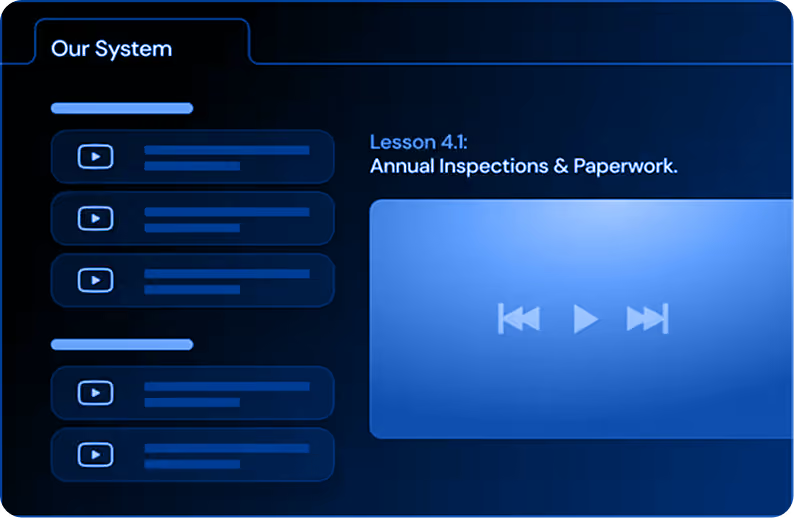
Our Section 8 Framework
The framework I use to build and manage a large Section 8 portfolio, adapted to your market, capital, and execution.

24/7 Support
Your investing plan is built around your budget, timelines, and goals, with fast answers whenever you need them.
.avif)
16 Live Coaching Calls a Month
Sixteen live group calls a month, four a week, plus ongoing support to keep you accountable and moving.
Live Strategy Sessions with me
Direct access to me and my team, and a step-by-step roadmap built around your situation.
Our Section 8 Framework
The framework I use to build and manage a large Section 8 portfolio, adapted to your market, capital, and execution.
24/7 Support
Your investing plan is built around your budget, timelines, and goals, with fast answers whenever you need them.
16 Live Coaching Calls a Month
Sixteen live group calls a month, four a week, plus ongoing support to keep you accountable and moving.
.avif)
Three Bonuses Included
On top of the coaching and deal reviews, three additions to help you pursue your first Section 8 rental, even with no prior experience.
Real-World Deal Breakdowns
Every week I break down a deal from my personal buy list.
.svg)
Learn how experienced investors evaluate properties
Learn how to think through risks, numbers, and assumptions
.avif)
Discounted Deal Opportunities Through Our Network
Skip the back-and-forth with homeowners, and learn how investors read pricing, comps, and value before making an offer.
Helps reduce overpaying upfront
Improves deal economics when executed correctly
Private Lending Education and Funding Insights (Only 15% Down)
Terms vary by lender, borrower profile, and market
How private lending works in real estate: common structures, requirements, and what investors weigh when financing Section 8 properties.
Learn how some investors build relationships with private lenders and evaluate funding structures in the $50k-$500k+ range
Apply these financing concepts to strengthen your acquisition strategy.
.avif)
The Section 8 Investor Framework
Built for investors who want to understand the model before they act.

Master the Framework
The decision-making framework for sizing up markets, properties, financing options, and Housing Authority requirements before you buy.

Build a Scalable Portfolio Strategy
How investors add properties over time: managing risk, allocating capital, and avoiding the mistakes that stall growth.

Systems, Team, and Execution
How experienced investors use property management, systems, and delegation to run rentals efficiently as portfolios grow.
Master the Framework
The decision-making framework for sizing up markets, properties, financing options, and Housing Authority requirements before you buy.
Build a Scalable Portfolio Strategy
How investors add properties over time: managing risk, allocating capital, and avoiding the mistakes that stall growth.
Systems, Team, and Execution
How experienced investors use property management, systems, and delegation to run rentals efficiently as portfolios grow.
What You'll Learn
Karim walks the full Section 8 investing process, start to finish.
Market Selection
Property Evaluation
Housing Authority Process
Financing Education
Deal Analysis
Inspections
Tenant & Management Systems
Scaling Strategy
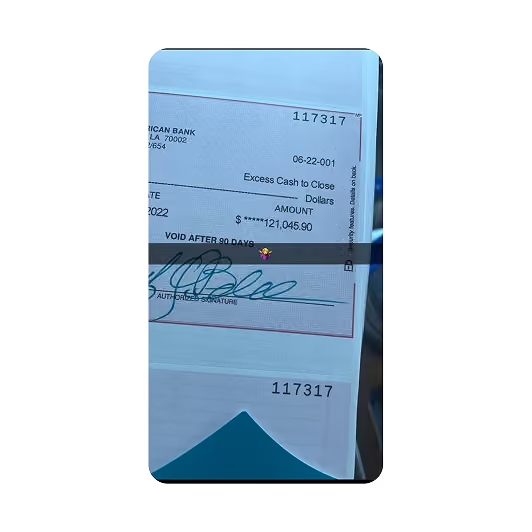
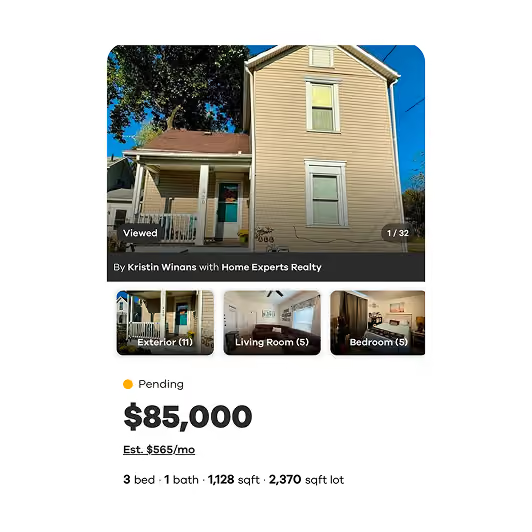
Other programs promise 100% returns on $10K down. Here's what a real deal looks like.
What that number does not include

Real people, real decision, real work
I’m giving you access to a structured framework that thousands have learned from. What happens next depends on how you execute.

.avif)
.avif)
.avif)
.avif)
.avif)


Who This IS for:

Aspiring Entrepreneurs
You want to understand how real estate actually works before risking capital. We break down the Section 8 model so you can avoid beginner mistakes and decide if this path makes sense for you.

9-5
Professionals
You’re exploring real estate while keeping your job. See how the Section 8 process works in the real world, and whether it fits your time, goals, and risk tolerance.

Real Estate Investors
You already know real estate and want a different rental model. See how Section 8 deals are structured, how payments work, and what experienced investors look for in long-term stability.

People who want more
You’re not chasing hype. You want skills, leverage, and a real understanding of how assets get built.
Aspiring Entrepreneurs
You want to understand how real estate actually works before risking capital. We break down the Section 8 model so you can avoid beginner mistakes and decide if this path makes sense for you.
9-5
Professionals
You’re exploring real estate while keeping your job. See how the Section 8 process works in the real world, and whether it fits your time, goals, and risk tolerance.
Real Estate Investors
You already know real estate and want a different rental model. See how Section 8 deals are structured, how payments work, and what experienced investors look for in long-term stability.
People who want more
You’re not chasing hype. You want skills, leverage, and a real understanding of how assets get built.
The Three Programs
Same curriculum, same community, same deal reviews. What changes is how long you have support and how much of the coaching is one-on-one.
Launchpad
Inner Circle
Legacy
What The Call Is (And What It Isn't)
And the refund policy, stated plainly
Walk through the deal before you buy one.
Choose the market.
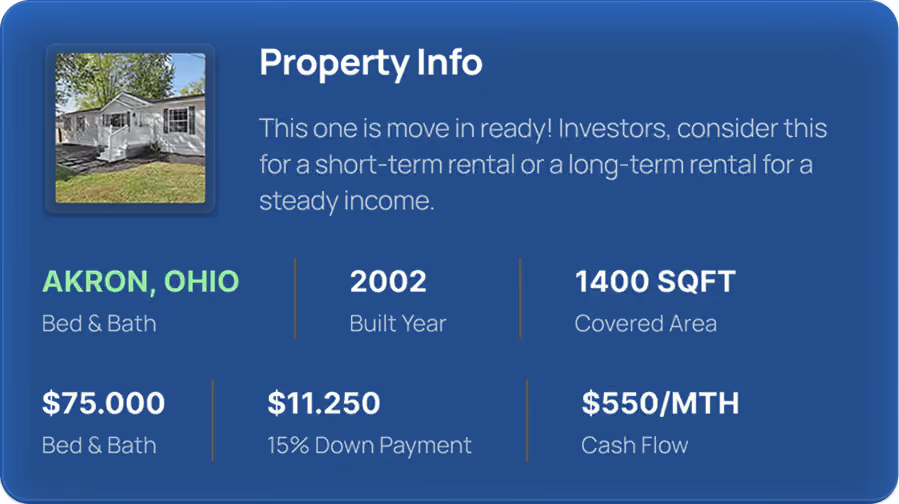
Every deal starts with a place, not an address you found on a ranking. This walkthrough follows one real purchase: a 1,400 square foot single family home in Akron, Ohio, built in 2002 and bought for $75,000. Wherever you buy, start with the local public housing authority. Payment standards, inspection process, and demand are all set locally, and they decide how a deal behaves.
Understand the cash required.
The purchase price is only the first line of the worksheet. Getting to the closing table takes the down payment, closing costs, and the reserves you set aside before a tenant ever moves in. On this house the down payment is documented: $11,250, which is 15 percent down. The other lines depend on your lender and your own policy, so the worksheet keeps them separate instead of guessing.
Prepare the property.
Before a voucher tenant moves in, the housing authority inspects the unit against its current standards. Those requirements are local and they change, so pull the checklist your authority uses today and walk the house with it. Inspections care about the systems a tenant lives with: heat, water, wiring, windows, smoke detectors. Cosmetic work alone does not get a unit approved.
Understand the rent.
Rent arrives in two labelled parts. The housing authority pays its assistance portion, and the tenant pays the share the authority assigns. Together they add up to the total rent to the owner. The payment standard you will hear about is an input the authority uses to calculate the subsidy, not a second payment stacked on top. Who pays utilities, and what rent the authority approves for the unit, both change the outcome.
Account for the expenses.
Cash flow is what survives the ledger: rent comes in, then debt service, operating expenses, and reserves come out. On the Akron house the documented result is $550 a month. The lines in between depend on your loan, your taxes, your insurance, and how you run the property, so treat any model as hypothetical until your own numbers are in it.
Now run your own numbersTools And Support Included In The Program
All of our best tools for success, in one place.
%201.svg)

%201.svg)

%201.svg)
%201.svg)



Frequently Asked Questions
The seven questions every serious investor asks before they start: capital, tenants, inspections, payment timing, investing from another state, whether the rent is really guaranteed, and whether this is legit. Straight answers, including the ones that are not flattering.
.svg)
More than the internet tells you. This is not a no-money-down strategy. You are buying a house on a lender's terms: a real down payment, real closing costs, and a real repair budget before a tenant ever moves in. That is why the application asks about capital up front and screens out anyone below $15K. If that is not you yet, I would rather tell you now than take your money. On the call we walk through the numbers line by line so you can decide with a calculator instead of a feeling.
Some tenants are hard on a house. That is true of every rental, voucher or not, and anyone who promises you otherwise is selling you something. What is different here is that you are not guessing: there is a paper trail, an inspection that puts eyes on the property, and a housing authority that holds real leverage over the tenant's voucher. Screening still does most of the work. I teach how I screen, what goes in the lease, and how to budget for turnover so one bad month does not become a bad year.
This is the part I learned from the other side of the desk. Inspections fail for a short, boring, repeatable list of reasons, and most investors fail them because nobody ever showed them the list. That is the core of the training: what the inspector is actually looking at, what to fix before they show up, and how to pass the first time instead of losing a month of rent waiting on a re-inspection.
The housing authority's portion is a direct deposit on a schedule, and it is the most predictable money in this business. Two honest caveats. First, the tenant's portion is still the tenant's, and that part can be late like any rent. Second, nothing gets paid until the unit passes inspection and the paperwork clears, so plan for a gap at the start of a tenancy instead of being surprised by it.
Yes, and plenty of people do, because the markets where the numbers work are usually not the markets where they live. But out of state is not hands off. You need a property manager or someone on the ground you actually trust, a contractor who answers the phone, and a way to verify what you are being told instead of hoping. We spend real time on building that team before you buy, not after.
No, and I do not use that word. Be careful with anyone who does. What is true: the housing authority's share is contracted, paid directly to you, and does not depend on your tenant's paycheck, which is a steadier position than a standard rental. What is not true: that it is guaranteed. Vouchers end, tenants move, units fail inspection, and program rules change. More reliable is the honest claim. Guaranteed is not.
You are going to Google me, and you should. You will find critics, and articles picking apart the kind of claims this industry makes. I would rather you hear that from me than find it afterward. So here is my position, plainly: this is paid education, not a business opportunity and not a done-for-you deal. I do not guarantee income and I do not make earnings claims. I worked inside the Section 8 system before I ever invested in it. That is the one thing in this niche nobody can copy. And the math on this page is deliberately unglamorous, because the honest version is the only version that survives a search. Read it, run your own numbers, and if it does not add up for you, do not apply.
Ready To Learn If Section 8 Investing Fits Your Goals?
Fill out the application to see if this is a fit. At a minimum, you’ll leave with a clearer understanding of how Section 8 real estate works.
.svg)
Section 8 rental investing education for serious operators.


