



BRRRR is the strategy investors reach for when they want one pile of cash to buy more than one house. You buy a property that needs work, fix it, rent it, refinance to pull your money back out, and repeat.
The question we hear from investors is whether BRRRR and Section 8 fit together. They do, and in one respect they fit better than BRRRR with a market-rate tenant: the rehab already has a written standard to hit, because the housing agency inspects the unit before the lease starts. But a voucher tenant also adds steps and time, and the refinance is where a lot of plans come apart.
This guide walks through BRRRR with Section 8 step by step: the purchase, the rehab budget, the inspection, the lease-up, the refinance, and the places it goes wrong.
BRRRR in plain English
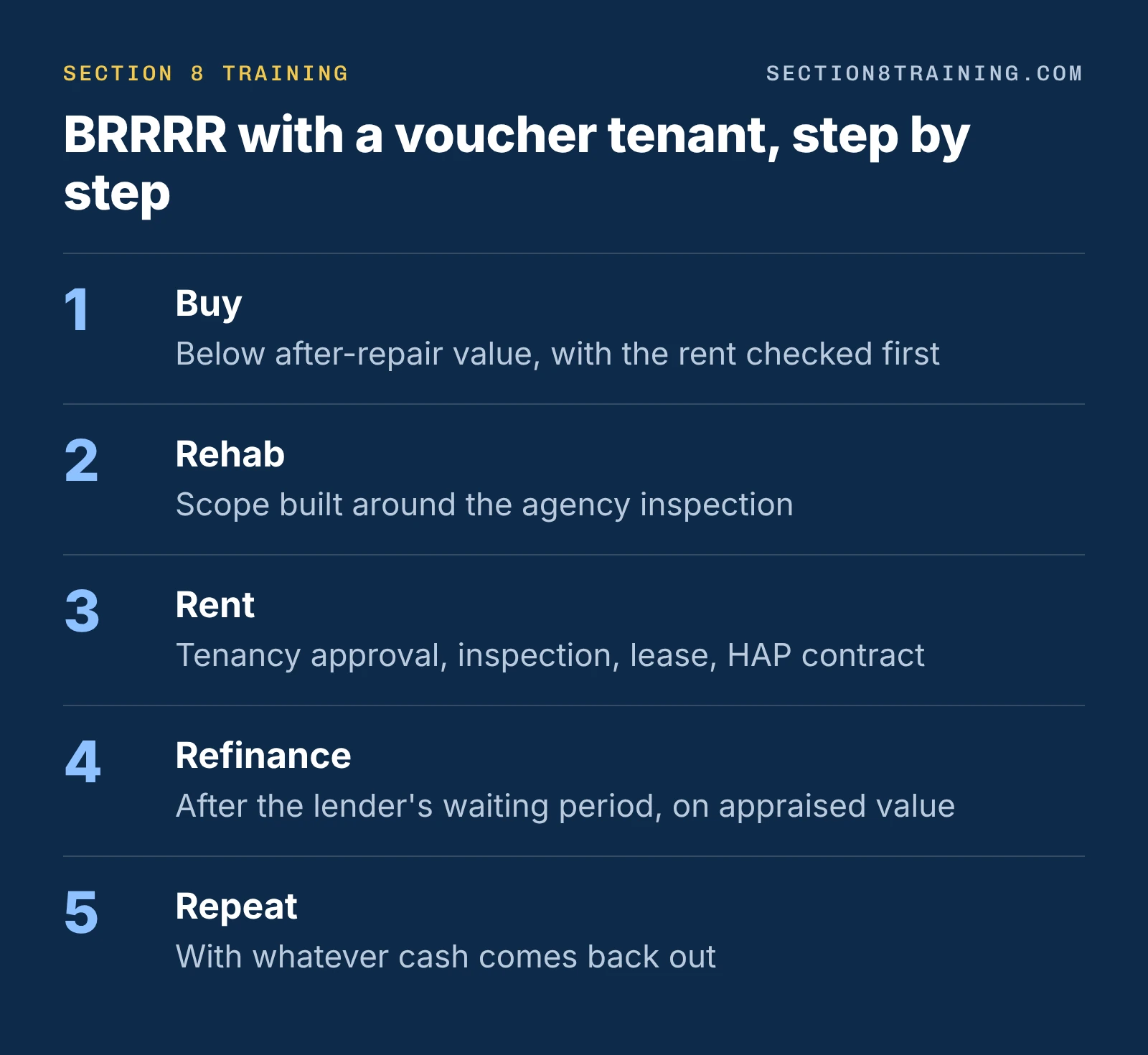
BRRRR stands for Buy, Rehab, Rent, Refinance, Repeat. The idea is simple:
- Buy a property below what it will be worth once it's fixed up.
- Rehab it to rental-ready condition.
- Rent it to a qualified tenant.
- Refinance with a long-term loan based on the new, higher value.
- Repeat with the cash you pulled out.
The math depends on one number: the after-repair value, usually shortened to ARV. If you're all in for $90,000 between purchase and repairs, and the house appraises for $120,000 afterward, a lender willing to loan 75 percent of value will lend $90,000. In that example you'd get your cash back and still own a rented house. Those are made-up numbers to show the mechanics. Real deals rarely land that cleanly, and many investors leave some money in.
What makes BRRRR harder than a normal purchase is that you're doing three risky things in a row: estimating repairs, estimating value, and counting on a loan you haven't been approved for yet.
Buying and the rehab budget
A BRRRR deal is won or lost at purchase. You need a price low enough that purchase plus repairs plus holding costs stays under the amount a lender will later refinance.
Work backward from the end:
- Estimate the ARV from recent sales of similar renovated homes nearby. Ask a local agent to pull them. Don't rely on online estimates.
- Estimate the refinance loan. Many lenders cap cash-out loans on rentals around 70 to 75 percent of appraised value. Ask your lender for their number.
- Subtract repairs, closing costs on both loans, and holding costs such as taxes, insurance, utilities, and loan payments during the rehab and lease-up.
- What's left is your maximum purchase price.
With a voucher tenant, add one more check before you buy: the rent. The rent an agency approves depends on its payment standard, the utility allowance, and whether the rent is reasonable compared with similar unassisted units. Look up the area's Fair Market Rents on HUD USER, then call the local agency and ask for the current payment standard for your bedroom size. This guide to how Fair Market Rent works explains how those numbers connect.
For a fuller picture of what a deal costs before the first rent check arrives, see the real cost of a Section 8 deal.
Rehab to pass inspection
This is where Section 8 helps a BRRRR investor. With a market-rate rental, "rent-ready" is whatever you decide it is. With a voucher tenant, the unit must pass the housing agency's inspection before the Housing Assistance Payments contract starts, so you know the standard in advance.
Build the inspection into your scope of work from day one:
- Safety items first. Working smoke and carbon monoxide alarms, safe electrical outlets and panels, secure handrails, no exposed wiring, and properly vented water heaters and furnaces.
- Water and heat. No leaks, working hot water, and a functioning permanent heat source.
- Windows and doors. They should open, close, and lock. Broken glass gets flagged.
- Paint. In homes built before 1978, peeling or chipping paint is a common failure because of lead rules.
- Kitchens and baths. They need to be working and sanitary. They don't need to be fancy.
Agencies have been moving from the older Housing Quality Standards to HUD's newer NSPIRE standard. This guide to NSPIRE inspections covers what inspectors look for.
The practical point for BRRRR is timing. A failed inspection means a re-inspection, and every extra week is another week of holding costs with no rent. Walk the house with the checklist before you request the inspection, and fix the small items before the inspector finds them.
One caution: rehab for durability, not for a flip. Hard-wearing flooring, simple fixtures, and solid mechanical systems matter more to a long-term rental than high-end finishes. The appraiser will give some credit for condition, but the long-term return comes from low repair costs.
Renting to a voucher holder
Once the rehab is done, the lease-up has more steps than a market-rate rental:
- List the unit and let applicants know you accept vouchers. Many agencies keep a listing site for owners.
- Screen the applicant the same way you'd screen anyone, with consistent written criteria. The agency confirms voucher eligibility. Choosing the tenant is still your job. This guide to Section 8 tenant screening explains what you can and can't consider.
- Submit the Request for Tenancy Approval with the proposed lease.
- Pass the inspection and wait for the agency's rent determination.
- Sign the lease and the HAP contract. This guide to the HAP contract explains what you're agreeing to.
How long this takes depends on the agency. Some move in a couple of weeks. Others take longer. Ask the agency how long tenancy approvals and inspections are currently running before you buy, and put that time in your holding cost estimate.
The refinance: seasoning and appraisal
The refinance is the step you control least, so plan it before you buy.
Seasoning. Many lenders won't do a cash-out refinance based on the new appraised value until you've owned the property for a set period. The waiting period depends on the loan type and the lender, and it's commonly somewhere between six and twelve months. Some lenders will refinance sooner but base the loan on your purchase price plus documented repairs instead of the new value. Ask the specific lender, in writing, before you close on the purchase.
How lenders view the rent. Lenders who make investor loans generally count rental income when they qualify you. For conventional loans, Fannie Mae's guidelines on rental income set out how lenders document and count it. DSCR lenders look mainly at whether the property's rent covers its payment. In both cases, a signed lease and a HAP contract are useful documentation, because they show the rent in writing. This guide to DSCR loans explains how that loan type works.
The appraisal. This is the biggest risk in BRRRR with Section 8. Many voucher-friendly neighborhoods have lower home values and fewer recent sales of renovated homes. If the appraisal comes in below your estimate, the lender loans less, and more of your cash stays in the deal. Strong rent doesn't raise the appraised value of a single-family home much, because those appraisals lean on comparable sales.
The new payment. Pulling cash out means a larger loan and a larger payment. Run the cash flow at the new payment, with realistic expenses, before you celebrate getting your money back. This breakdown of the numbers nobody shows you before you buy a Section 8 rental lists the expense lines to include.
Where BRRRR goes wrong
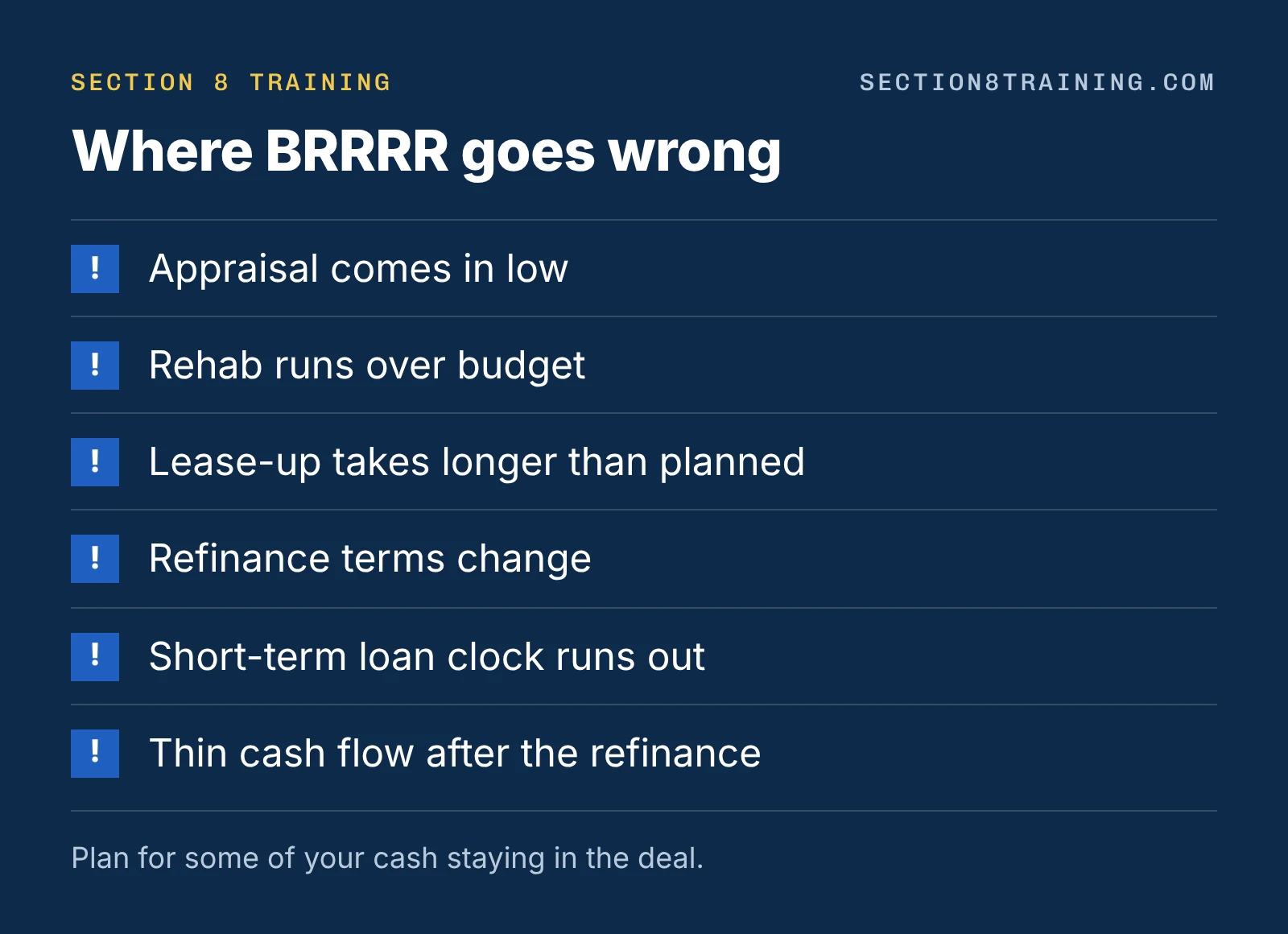
BRRRR fails in predictable ways. Know them going in.
- The appraisal comes in low. You planned to pull out all your cash, and you get half of it. Have a plan for leaving money in the deal.
- The rehab runs over. Older homes hide problems behind walls. Carry a contingency of 10 to 20 percent of the repair budget.
- The lease-up takes longer than planned. Inspections, paperwork, and tenant move-in dates add weeks. Budget several months of holding costs.
- The refinance terms change. Rates and lender rules move. A deal that works at one rate can turn negative at another.
- Short-term loan pressure. If you bought with a hard money or private loan, the clock is running. A delay at any step gets expensive quickly.
- Thin cash flow after refinancing. A property financed to the limit has little cushion for repairs or vacancy.
A conservative version of BRRRR is to treat full cash recovery as a bonus. If the deal still works with a quarter or a third of your money left in, it's a sound rental. If it only works when everything goes right, it's a gamble.
Is BRRRR with Section 8 right for you?
It fits investors who have some rehab experience or a trusted contractor, enough reserves to cover delays, a lender lined up for the refinance, and a market where renovated homes sell for clearly more than distressed ones.
It's a poor fit for a first deal if you have no reserve beyond the purchase and repair budget, or if you can't visit the property or rely on someone who can. A simpler first purchase, such as a rent-ready house with conventional or DSCR financing, teaches you the agency process with less at stake. Our guide to financing a Section 8 rental compares the options, and how much money you need to start covers the cash side.
Plan the refinance before you buy
BRRRR rewards investors who do the last step first. Know your lender, your seasoning period, your realistic appraisal range, and your cash flow at the new payment before you make an offer.
Section 8 Training helps investors with $15,000 or more ready to invest work through deals like this one, from market and rent checks to inspection prep and financing. If you're weighing a BRRRR deal or deciding whether to start with something simpler, apply and book a strategy call. It's a 30-minute conversation about your capital, your market, and your next step. Real estate carries risk, and results depend on your market, financing, and how you run the property.


