



A surprising number of people researching Section 8 investing don't live in the United States. Some are in Canada, where home prices make local rentals hard to justify. Others are in the UK, the Gulf, Europe, or Australia, looking for steady US rental income priced in dollars.
The first question is always the same: can non-US citizens invest in Section 8 at all?
Yes. There's no federal rule that stops a foreign national from owning a US rental property or renting it to a household with a Housing Choice Voucher. The housing agency cares whether the unit passes inspection, whether the rent is reasonable, and whether the owner signs and follows the HAP contract. It doesn't require the owner to be a US citizen or resident.
But "allowed" and "simple" are different things. Foreign investors face extra steps on financing, banking, taxes, and paperwork, and the mistakes cost more because you're far away. This guide to Section 8 investing for foreign investors covers each one in the order you'll hit it.
A quick note before we start: tax and legal rules for foreign owners are specific to your country, your residency, and your situation. Use this guide to understand the moving parts and ask better questions. Then work with a US tax professional who handles non-resident clients, and a cross-border advisor if your home country taxes worldwide income.
Can foreign investors own Section 8 rentals?
At the federal level, yes. Foreign individuals and foreign-owned companies can buy residential property in the US, and nothing in the voucher program limits who can be a participating owner, as long as the owner isn't barred for program reasons such as past fraud or being related to the tenant.
At the state level, the picture has shifted. Over the past few years, a number of states have passed laws restricting property purchases by people or companies connected to certain foreign countries, usually focused on farmland or land near military bases and critical infrastructure. Most foreign investors buying single-family homes in residential neighborhoods aren't affected, but check the current rules in the state you're buying in before you make an offer. Your US real estate attorney can confirm this in a few minutes.
Owning a US rental also doesn't give you any immigration status. It doesn't count toward a visa, residency, or a green card, and visiting your property doesn't change that. Passive ownership is generally treated differently from working in the US, but if you plan to spend significant time in the US managing properties yourself, talk to an immigration attorney.
Here's what the voucher program itself requires of any owner, foreign or domestic:
- A unit that passes the housing agency's inspection
- A rent the agency approves as reasonable for the area
- A signed HAP contract and lease with the tenant
- A taxpayer identification number and bank account for payments
- Compliance with fair housing law and the lease terms
None of those depend on your citizenship. Several of them, especially the taxpayer number and bank account, take more work when you live abroad.
The order of operations
Foreign investors who get stuck usually do things out of order. They find a house first, then discover they can't open a bank account or get a loan in time to close.
Here's the sequence that tends to work:
- Talk to a US tax professional who works with non-resident investors. Decide how you'll own the property.
- Form your entity if you're using one, and get its EIN.
- Open a US bank account for the property or entity.
- Get pre-approved for a foreign national loan, or confirm your cash funds can move.
- Pick a market and build your local team: agent, inspector, property manager, attorney or title company.
- Make offers.
- Close, register with the housing agency, and file the right tax forms with your manager.
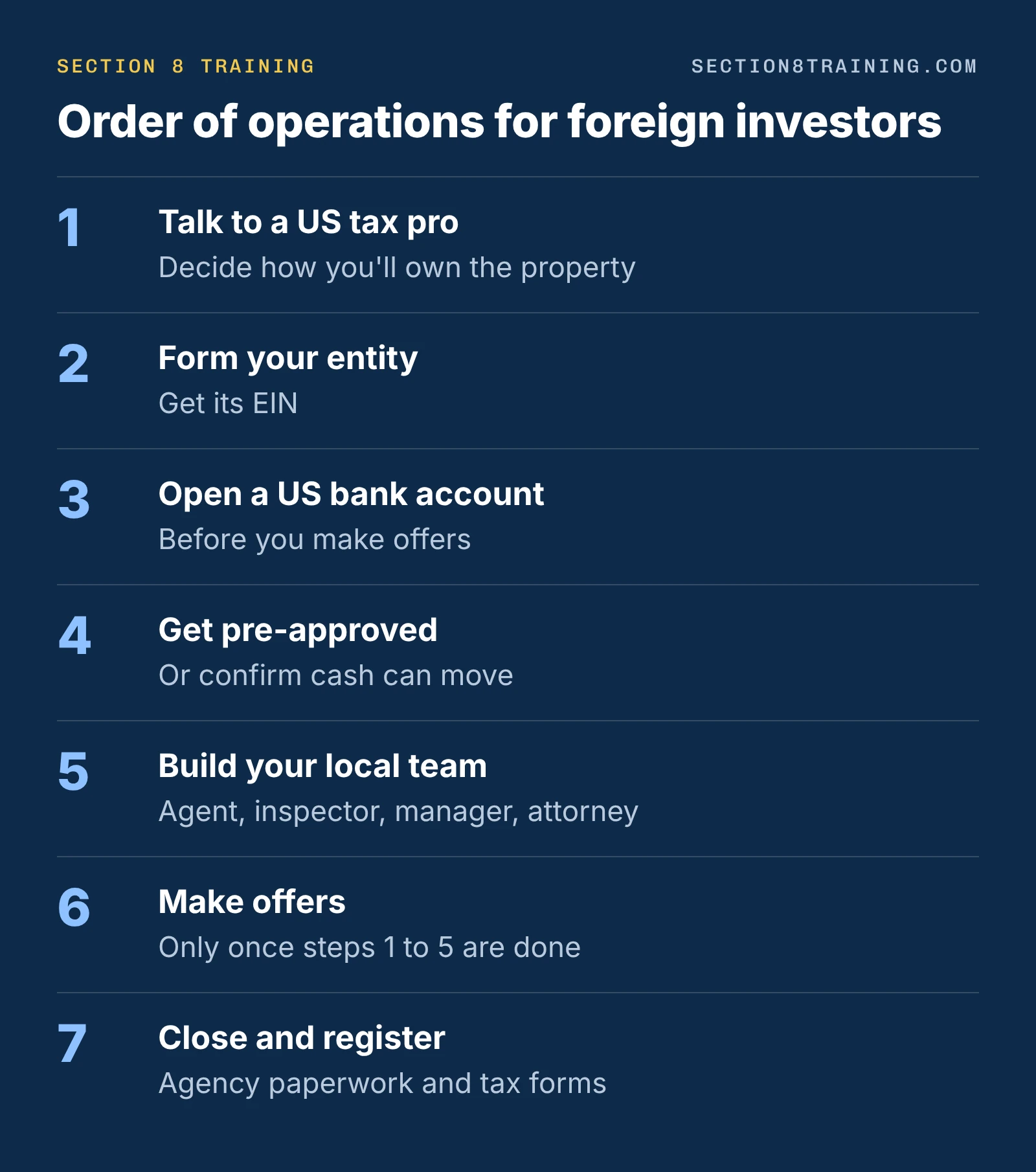
Steps one through four can take several weeks to a few months. Start them before you get attached to a property.
Financing as a foreign national
Most foreign investors either pay cash or use a foreign national loan.
Paying cash
Cash is the simplest route. There's no US credit history required, no lender appraisal timeline, and fewer documents. The trade-off is that your money is tied up in one property instead of spread across several, and you'll need to move funds internationally, which means planning around transfer limits, exchange rates, and your bank's compliance checks.
If you go this route, move funds into your US account well before closing. International wires can be delayed by compliance reviews, and a closing date won't wait.
Foreign national loans
Many US lenders offer loans built for buyers without US credit or a Social Security number. For rentals, these are often structured like DSCR loans, meaning the lender qualifies the property based on its expected rent rather than your personal income. That fits Section 8 well, because the housing agency's approved rent is a documented number.
Expect these differences from a typical US investor loan:
- Larger down payments. Foreign national programs commonly ask for more money down than domestic loans. Plan for a meaningful share of the price in cash.
- Higher rates. The lender is taking more risk and has less information, so pricing is usually higher.
- More documents. Passport, proof of address, foreign bank statements, sometimes a credit report or reference letter from your home country.
- Reserves. Lenders often want several months of payments sitting in a US account after closing.
- Entity requirements. Some lenders will only lend to a US LLC, not to you personally.
Rates and terms change often, so compare at least two or three lenders. Ask each one specifically whether they've closed loans on properties with Housing Choice Voucher tenants, and how they treat the HAP rent when underwriting. Some lenders are comfortable with it, and some aren't.
For a fuller comparison of US loan types, see our guide to how to finance your first Section 8 rental. To see how much cash a typical first deal needs, read how much money you need to start Section 8 investing.
Setting up an LLC and a US bank account
Do you need an LLC?
You can own a US rental in your own name as a foreign individual. Many foreign investors still use a US LLC for liability protection, easier banking, and lender requirements. Some use more complex structures for estate tax planning.
The right choice depends heavily on your home country. A few examples of why:
- Canadian residents should be careful with US LLCs. Canada generally doesn't treat an LLC the way the US does, which can lead to double taxation if it isn't structured carefully. Many Canadians own US rentals personally or through other structures. A cross-border accountant should make this call.
- Investors from countries with a US tax treaty may have options that change how rental income or gains are taxed. Treaties differ a lot.
- Investors worried about US estate tax often look at structures beyond a simple LLC, because a single-member LLC owned by a foreign individual doesn't by itself remove the property from the US estate tax.
Forming the LLC and getting an EIN
You can form an LLC in most states without being a US resident. You'll need a registered agent with a US address. Once it's formed, the LLC needs an Employer Identification Number from the IRS. The IRS's online EIN application requires the responsible party to have a US taxpayer number, so foreign owners without one usually apply by fax or mail, which takes longer.
One filing many foreign owners miss: a US single-member LLC owned by a foreign person generally has to file an annual information return with the IRS, even if it owes no tax. The penalty for missing it can be steep. Ask your tax professional about it at setup, not at tax time.
Opening a US bank account
This is often the slowest step. Many US banks require a Social Security number or an in-person visit for non-residents. Some will open accounts for a US LLC with a foreign owner using the LLC's EIN, your passport, and formation documents. Others won't.
Ways foreign investors usually solve this:
- Visit the US and open accounts in person at a bank that works with non-residents
- Use a bank recommended by your lender, attorney, or property manager
- Use an international bank with US branches, if you already bank with one at home
You'll want this account open before closing, both for the down payment and because the housing agency and your property manager will need it for payments.
Taxes and withholding basics
US taxes are where foreign investors most often get surprised. Here are the main pieces, in plain language. Your tax professional will fill in the specifics.
Taxpayer identification numbers
You don't need a US taxpayer number just to buy property. You will need one to file US tax returns. Foreign individuals generally apply for an Individual Taxpayer Identification Number (ITIN) using Form W-7, usually alongside their first tax return. An LLC or corporation uses its EIN.
The housing agency and your property manager will also ask for tax information before they pay you. Which form you give them depends on how you own the property, so ask your tax professional which form applies before closing.
The 30% withholding on rent, and the net election
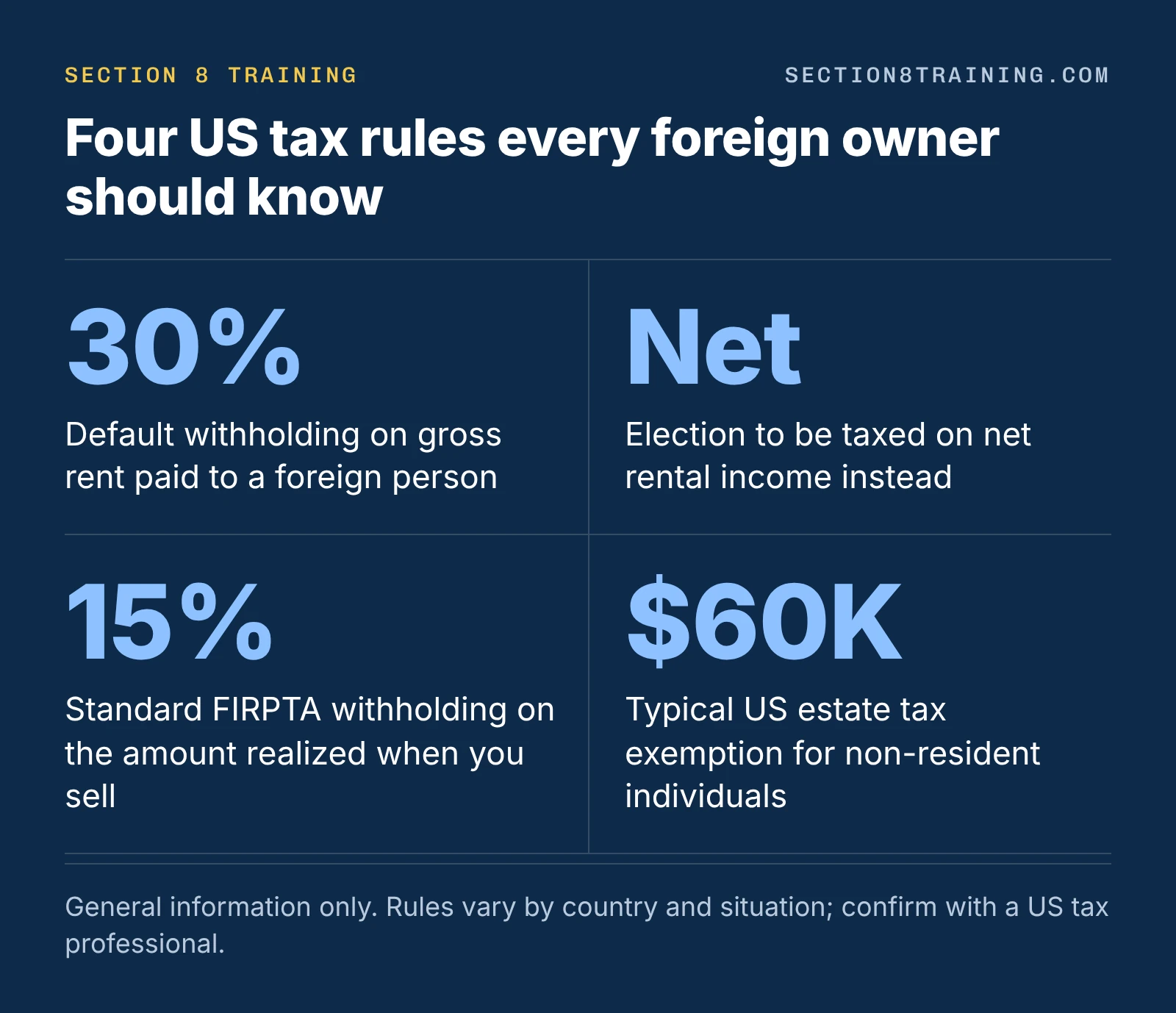
By default, rental income paid to a foreign person is subject to 30% withholding on the gross rent, not the profit. On a rental that brings in $1,400 a month, that's $420 a month withheld before any mortgage, taxes, insurance, or repairs. For most financed rentals, that would wipe out cash flow.
Most foreign investors avoid this by electing to treat the rental income as effectively connected with a US trade or business. With that election, you're taxed on net rental income, after expenses and depreciation, at regular graduated rates. You file a US non-resident return each year, and you give the party paying you rent the appropriate form so they don't withhold 30% on the gross.
In practice, that means setting this up with your property manager before the first rent payment. If your manager withholds 30% for months because nobody sent the right form, you'll eventually get it back through your tax return, but your cash flow will suffer in the meantime.
Depreciation still matters
Foreign owners who file on a net basis can generally claim depreciation on the building, just like US owners. That often reduces taxable rental income significantly in the early years. It also gets recaptured when you sell, which is one more reason to plan your exit with a professional.
FIRPTA when you sell
When a foreign person sells US real estate, the buyer is generally required to withhold a portion of the sale price and send it to the IRS. Under the IRS FIRPTA withholding rules, the standard rate is 15% of the amount realized, with exceptions and reduced rates in some situations, such as certain sales where the buyer will live in the home.
That withholding is a prepayment, not your final tax. If your actual tax on the gain is lower, you file a return to get the difference back. You can also apply to the IRS in advance for a reduced withholding amount, which can help if most of your sale proceeds are needed to pay off a loan.
US estate tax
Non-resident foreign individuals who own US property directly face a much smaller US estate tax exemption than US citizens, generally $60,000 compared with the multi-million-dollar exemption for citizens. Depending on your country's treaty with the US, this can be a big issue for heirs. It's one of the main reasons foreign investors use specific ownership structures, so raise it early with your advisor.
Your home country taxes, too
If your home country taxes residents on worldwide income, you'll usually report the US rental there as well, often with a credit for US taxes paid. Canadian residents, for example, report US rental income on their Canadian return and may have additional foreign property reporting requirements. Keep good records on both sides, and make sure your US and home-country accountants talk to each other.
Managing a Section 8 rental from abroad
If you live overseas, you're already an out-of-state investor in the most extreme sense. The good news is that Section 8 suits remote ownership when the right team is in place.
Why Section 8 can work well for remote owners
- Payment reliability. The housing agency's portion of the rent arrives by direct deposit each month as long as the unit stays in compliance. For a remote owner, that predictability matters.
- Documented rent. The approved rent and the tenant's share are set in writing, which makes underwriting and budgeting easier.
- Regular inspections. The agency inspects the unit periodically, which gives you an independent check on its condition.
What changes when you're far away
- You can't step in yourself. Every repair, showing, and inspection depends on your manager. Choosing a manager who knows the voucher program is the most important hire you'll make.
- Time zones slow decisions. Set a repair approval limit so your manager doesn't wait 12 hours for your answer on a $250 repair.
- You need US-based document handling. Agencies, lenders, and title companies sometimes need wet signatures or notarized documents. Find out how your country handles US notarization or apostilles before you need it.
Questions to ask a property manager
- How many Housing Choice Voucher units do you manage in this market?
- How do you handle failed inspections and re-inspections?
- Who submits rent increase requests to the housing agency, and how often?
- Do you have other foreign owners? How do you handle tax forms for them?
- What's your repair approval process, and can I set a dollar limit?
- How quickly do you send monthly statements, and what's included?
The landlord side of the program, including what your manager will be doing on your behalf, is explained in this guide to how to apply for Section 8 as a property owner. If you're still choosing where to buy, this list of the best states for Section 8 investing is a good starting point.
Choosing a market from overseas
Without the option of driving around neighborhoods, foreign investors rely more on data and local people. Focus on:
- Payment standards and Fair Market Rents compared with purchase prices, which tell you whether the numbers can work
- The local housing agency's reputation for processing inspections and paperwork on time
- Landlord-tenant law, including how long evictions take and how security deposits are handled
- Property taxes and insurance costs, which vary a lot from state to state and can turn a good deal into a thin one
- Depth of the local team, meaning whether there are several experienced managers, agents, and contractors to choose from
If you can visit once before buying, spend that trip meeting your manager, agent, and lender in person and driving the neighborhoods you're considering. One visit can save you from a market that looks good on a spreadsheet and feels wrong on the street. This list of the best cities for Section 8 investing can help you shortlist where to look.
Common mistakes foreign investors make
Finding the house before the bank account. If you can't move money or open an account in time, you'll lose the deal or scramble at closing.
Letting 30% withholding happen by default. Set up the net election paperwork with your manager before rent starts.
Copying a structure from a US friend. An LLC that works perfectly for an American can create double taxation for a Canadian or estate tax exposure for someone in another country.
Ignoring estate planning. The low estate tax exemption for non-residents surprises a lot of families. Plan for it from the start.
Choosing a manager on price. A cheap manager who doesn't understand the voucher program costs more in lost rent than the fee you save.
Underestimating reserves. Repairs, vacancies, and currency swings all hit harder when you're far away. Keep more cash in your US account than you think you need.
Assuming visits are optional forever. You can own remotely, but plan to see your properties in person every so often.
For a balanced view of what can go wrong in Section 8 investing generally, read this honest look at Section 8 investing risks.
Quick answers for foreign investors
Do I need to visit the US to buy a Section 8 rental?
Not always. Many closings can be done remotely with notarized documents, though some banks and lenders want an in-person visit to open accounts. One trip before you buy is still worth it.
Can I get a DSCR loan as a foreign national?
Many lenders offer foreign national programs that qualify the property on rent, much like a DSCR loan. Expect a larger down payment, a higher rate, and reserve requirements.
Will the housing agency treat me differently because I live abroad?
The agency applies the same rules to every owner. What changes is logistics: you'll rely on your manager to attend inspections and handle paperwork, and you'll need a US bank account for payments.
Can a Canadian buy a Section 8 rental personally?
Yes. Many Canadian residents own US rentals in their own name. Talk to a cross-border accountant before choosing between personal ownership and any entity.
Is Section 8 investing from abroad right for you?
It can be a good fit if you have capital to invest, you're comfortable working through a US team, and you're willing to pay for good tax and legal advice up front. It's a harder fit if you're hoping to manage everything yourself from overseas, or if you'd be stretching to cover the larger down payment that foreign national loans often require.
The investors who do well from abroad treat the first property as a setup project. They get the structure, banking, tax filings, and team right once, and then the second property is far easier than the first.
Get help planning your first US deal
Buying a Section 8 rental from outside the US is very doable, but there are more moving parts than most guides admit, and the order you handle them in matters.
Section 8 Training works with investors in the US and abroad who have $15,000 or more ready to invest and want a structured path to their first voucher rental. The program covers market selection, deal analysis, financing options, building a remote team, and working with housing agencies. If you're investing from Canada or overseas, apply and book a strategy call. It's a 30-minute conversation about your capital, your country, and your timeline, and you'll come away knowing whether the program fits.


