



Most people who ask about Section 8 investing already have a job. They work 40 or 50 hours a week, they have a commute, and many of them have kids. The question they really want answered isn't "how does the voucher program work." It's "can I actually do this without quitting?"
You can. Plenty of investors buy and run Section 8 rentals around a W-2 schedule, and the job often helps more than it hurts. It gives you steady income that lenders like, a cushion for repairs, and a reason to build systems instead of doing everything yourself.
What it won't give you is free weekdays. This guide is about working around that honestly: how many hours Section 8 investing with a full-time job really takes, what you should handle personally, what to hand off, and where people with jobs usually get stuck.
How many hours it really takes
The time Section 8 investing takes isn't spread evenly. It comes in bursts, and the heaviest burst is before and just after your first purchase.
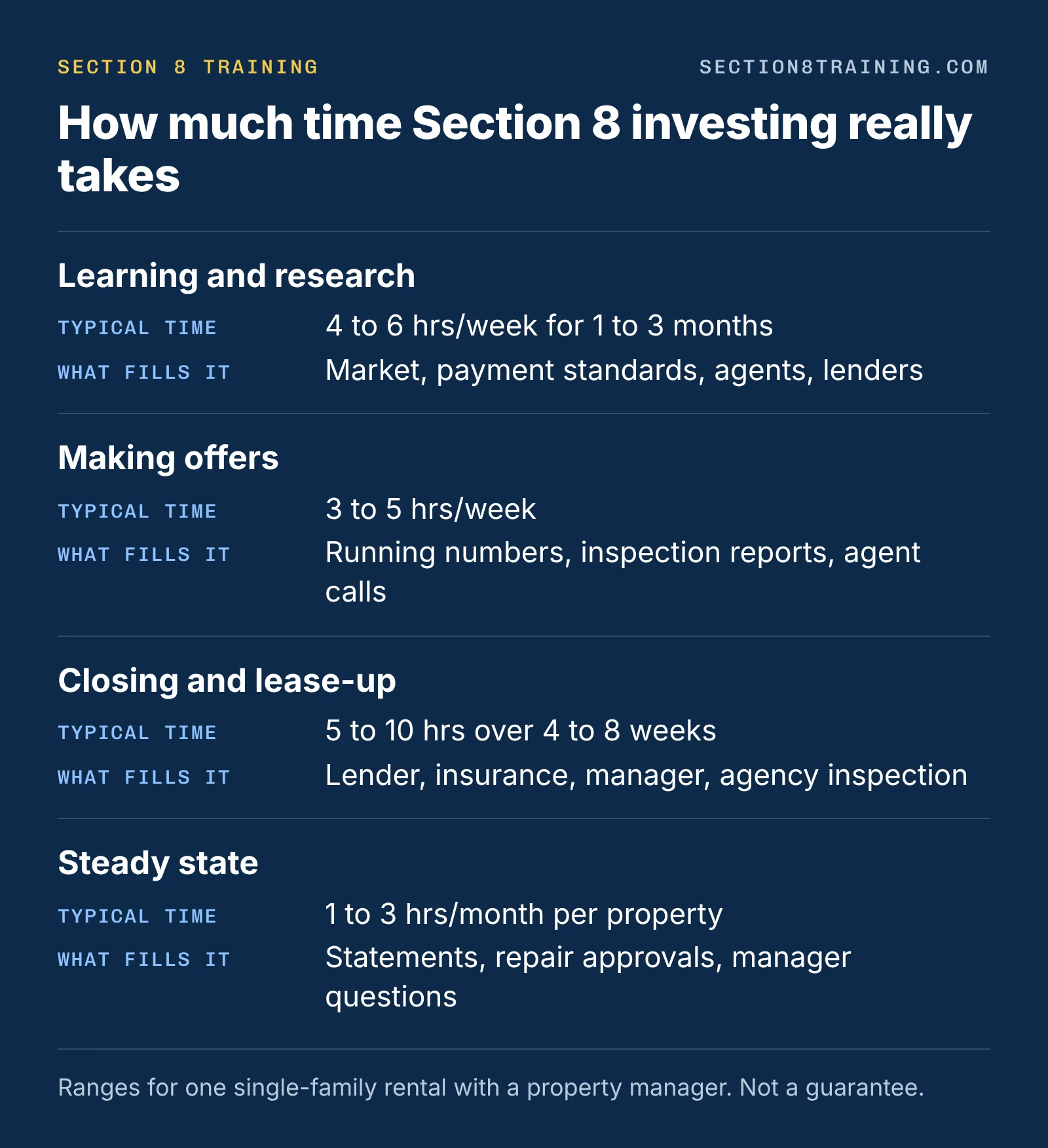
Here's a realistic picture for one single-family rental, assuming you use a property manager and a local agent:
- Learning and market research. Typical time: 4 to 6 hours a week for 1 to 3 months; What fills it: Picking a market, learning payment standards, talking to agents and lenders.
- Making offers. Typical time: 3 to 5 hours a week; What fills it: Running numbers on listings, reviewing inspection reports, calls with your agent.
- Closing and lease-up. Typical time: 5 to 10 hours spread over 4 to 8 weeks; What fills it: Lender paperwork, insurance, hiring a manager, the housing agency's inspection and approval.
- Steady state. Typical time: 1 to 3 hours a month per property; What fills it: Reviewing statements, approving repairs, answering your manager's questions.
These are ranges, not promises. A house that needs repairs before it passes inspection takes more of your attention than one that's ready to rent. Your first deal also takes longer than your third, because you're learning the process and building the team at the same time.
The important part for someone with a job is the last row. Once a property is stabilized with a good tenant and a good manager, it usually needs a few hours a month, and most of that can happen on a lunch break or after the kids are asleep.
What you do vs what you delegate
People who struggle with Section 8 investing around a full-time job usually try to do the wrong things themselves. They show up to fix a leaking faucet and then skip the deal analysis because they're tired.
Flip that. Keep the decisions and delegate the labor.
Keep these yourself:
- Choosing the market and the price range
- Deciding which deals to offer on and at what price
- Picking your lender, property manager, and inspector
- Approving any repair over a set dollar limit
- Reviewing your monthly statement and year-end numbers
Hand these off:
- Showings and tenant screening
- Rent collection and the tenant's portion of rent
- Scheduling and attending housing agency inspections
- Routine maintenance and emergency calls
- Lease renewals and rent increase paperwork with the agency
That second list is roughly what a property manager does. Fees vary by market and contract, so get the full fee schedule in writing, including leasing fees and markups on repairs, before you sign. If you want to understand what your manager is actually doing on your behalf, the landlord side of the program is covered in this guide to Section 8 landlord responsibilities.
Some investors with jobs self-manage a property close to home. That can work, but be honest about it. A tenant's water heater doesn't fail on your schedule, and housing agency inspections usually happen during business hours. If you self-manage, you need a handyman you trust and a boss who doesn't mind the occasional long lunch.
Using your W-2 income to qualify
Here's where having a job turns into an advantage.
When you apply for a conventional mortgage on a rental, the lender looks at your debt-to-income ratio, your credit, and your work history. Two years of steady W-2 income in the same field is about as clean a file as a lender sees. Self-employed investors often have a harder time, because their taxable income is lower after write-offs.
Your job helps in a few specific ways:
- Conventional loans. Steady pay can qualify you for lower rates and smaller down payments than many investor-only loans.
- Reserves. Lenders want to see cash left over after closing. A paycheck that keeps refilling your savings makes that easier to show.
- Repairs and vacancies. If a property sits empty while the agency processes paperwork, your income covers the mortgage without panic.
Your job doesn't help as much with DSCR loans, which qualify the property based on its rent rather than your income. Many investors start with a conventional loan while they have W-2 income, then add DSCR loans as their debt-to-income ratio fills up. This walkthrough on how to finance your first Section 8 rental compares the main loan types, and how much money you need to start breaks down the cash side.
One thing to check before you start: your employer's policy on outside business activity. Most employers don't care about passive rental income, but some industries, such as banking, government, and certain licensed professions, have disclosure rules. Read your handbook or ask HR. It's a five-minute question that can save you a real headache.
A weekly schedule that works
You don't need a perfect routine. You need a small, repeatable one that survives a bad week at work.
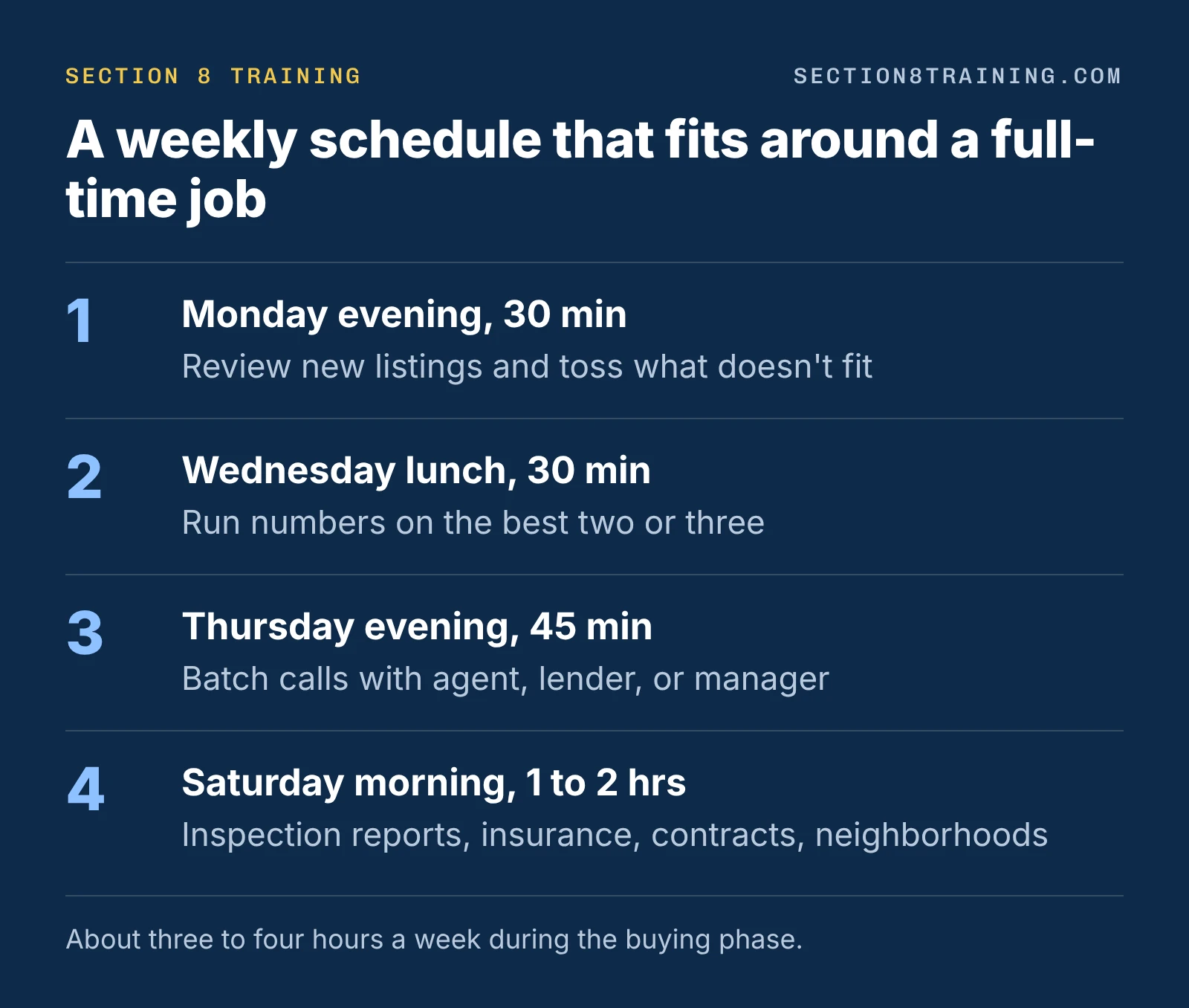
Here's a schedule many working investors use during the buying phase:
- Monday evening (30 minutes): Review new listings your agent sent. Toss anything that doesn't fit your price range or neighborhood list.
- Wednesday lunch (30 minutes): Run the numbers on the two or three best candidates. Check the rent against the local payment standard and utility allowance, using the area's Fair Market Rents on HUD USER as a starting point.
- Thursday evening (45 minutes): Calls with your agent, lender, or property manager. Batch them so you're not on the phone every night.
- Saturday morning (1 to 2 hours): Deeper work. Read inspection reports, compare insurance quotes, review a contract, or study a new neighborhood.
That's three to four hours a week. It's enough to make steady progress without burning out, and it fits around most jobs.
Once you own a stabilized property, it shrinks to something like this:
- Monthly (30 to 60 minutes): Read your owner statement, check that the housing assistance payment and the tenant's share both arrived, and review any repair invoices.
- When your manager calls: Approve or decline repairs over your limit. Most of these are quick yes-or-no decisions.
- Yearly (2 to 3 hours): Review the annual inspection result, the lease renewal, any rent increase request, and your tax documents.
Buying out of state when you work locally
Many people with full-time jobs live in expensive metros where Section 8 numbers don't work. That pushes them toward markets they can't drive to.
Buying out of state actually suits a working schedule, because it forces you to build the team you'd need anyway. You can't fix the faucet yourself from 800 miles away, so you hire someone who can. The trade-off is that you rely more on your agent, inspector, and manager, and choosing them well becomes your most important job.
If you're weighing markets, this list of the best states for Section 8 investing is a good place to start. If you're still narrowing it down by city, this list of the best cities for Section 8 investing goes a level deeper.
Where people with jobs get stuck
Most working investors don't fail because they lack time. They stall for a few predictable reasons.
They research forever. Six months of podcasts and no offers. Set a deadline for picking a market, and after that, every week should include at least one deal you've actually analyzed.
They pick a market by headlines. A city that's cheap isn't automatically a good Section 8 market. You need decent payment standards, a housing agency that processes paperwork in a reasonable time, and neighborhoods where you'd be comfortable owning.
They hire the cheapest manager. A manager who doesn't understand the voucher program can cost you months of rent through slow inspections and missed paperwork. Ask specifically how many Section 8 units they manage and how they handle failed inspections.
They skip reserves. A job covers small surprises, but not a roof and a vacancy in the same month. Keep a separate reserve for each property.
They try to scale too fast. One stabilized property teaches you more than three half-finished ones. Get the first one running smoothly before you buy the second.
None of these are about intelligence or effort. They're about structure, and structure is something you can borrow from people who've done it before. If you want a broader look at the trade-offs before you commit, read this honest breakdown of Section 8 investing risks.
Is Section 8 investing realistic for you right now?
It's a good fit if you have steady income, some savings you can put to work, and a few hours a week you can protect. It's a harder fit if your job is unpredictable, you have no savings cushion, or you're hoping rentals will replace your paycheck in the first year.
Section 8 rentals can add income over time. They don't usually change your life in the first 12 months, and anyone who tells you otherwise is skipping the part about repairs, vacancies, and learning curves. If you're starting from zero, Section 8 investing for beginners explains how the program works from the owner's side.
Getting help without quitting your job
The hardest part of investing around a full-time job isn't the hours. It's not knowing which decisions matter and which ones you can stop worrying about. That's where working with people who've already built the systems saves the most time.
Section 8 Training is built for working investors who want a structured path: picking a market, analyzing deals, building a remote team, and getting through the housing agency process without guessing. It's designed for people with $15,000 or more ready to invest. If that sounds like you, apply and book a strategy call. It's a 30-minute conversation about your capital, your schedule, and your goals, and you'll know by the end whether the program fits. If you'd like an outside view of the program first, read the Section 8 Training review.


