




Seller financing comes up in almost every conversation about buying rentals with less money down. You've probably heard a version of the pitch: skip the bank, let the seller be the lender, and close on a cash-flowing rental with a small down payment.
Sometimes that's exactly how it works. Other times, a seller-financed deal is a bad property with a friendly payment plan attached, or a contract that falls apart when the balloon payment comes due.
If you've been searching for how seller financing, Section 8 rules, and the housing agency fit together, this guide walks through it from start to finish: what it is, why sellers agree to it, the terms worth negotiating, the two risks that sink most deals, and the part most guides skip entirely, which is getting the housing agency to pay you as the new owner.
What seller financing is
In a seller-financed sale, the seller acts as your lender for some or all of the purchase price. Instead of a bank wiring the money at closing, you sign a promissory note to the seller and pay them monthly, usually with interest, over an agreed term.
The seller's protection is the property itself. If you stop paying, they can take it back through foreclosure or, under some contract types, through a faster forfeiture process set by state law.
Seller financing for an investment property usually takes one of these forms:
- Promissory note and mortgage or deed of trust. Who holds title: You; How it works: You get the deed at closing and the seller records a lien, just like a bank would; Main risk for you: Standard foreclosure risk if you default.
- Seller second (partial financing). Who holds title: You; How it works: A bank lends most of the price and the seller carries a smaller second loan; Main risk for you: The bank must allow the second lien.
- Land contract (contract for deed). Who holds title: Seller, until paid off; How it works: You make payments and get the deed at the end; Main risk for you: You may not have full ownership rights in the meantime.
- Wraparound. Who holds title: You, subject to the seller's loan; How it works: Your payment to the seller covers their existing mortgage plus a spread; Main risk for you: The seller's lender can call their loan due.
- Lease option. Who holds title: Seller; How it works: You rent with the right to buy later; Main risk for you: You're a tenant, not an owner, until you exercise the option.
For a Section 8 rental, the first two are usually the cleanest. You own the property, your name is on the deed, and the housing agency can treat you as the owner from day one. Land contracts and lease options can create problems with the agency, which we'll cover below.
Why sellers agree to it
Seller financing only works if the seller wants it, so it helps to understand who says yes.
Owners who own the property free and clear. This is the big one. A seller with no mortgage can carry a note without asking anyone's permission. Long-time landlords who bought decades ago are a common example.
Tired landlords who want income, not a lump sum. Some older owners don't want to manage tenants anymore, but they like monthly checks. A note gives them income without toilets and phone calls.
Sellers facing a big tax bill. Spreading payments over several years can spread the gain over several tax years. The IRS calls this an installment sale. There's a catch for rental sellers: depreciation recapture is generally reported in the year of the sale, even if payments come later. Their accountant will tell them whether the trade-off works.
Properties that are hard to finance. A house that needs work, or one in a lower-priced neighborhood where banks are slow to lend, can sit on the market. Seller financing widens the buyer pool.
Sellers who want a higher price. Some sellers will accept better terms in exchange for a higher price, or a lower price in exchange for more cash down. That trade is the heart of most seller financing negotiations.
If you're looking for these sellers, direct outreach to long-time owners and local investor networks are where most of them come from. They rarely advertise "owner financing available."
Terms to negotiate
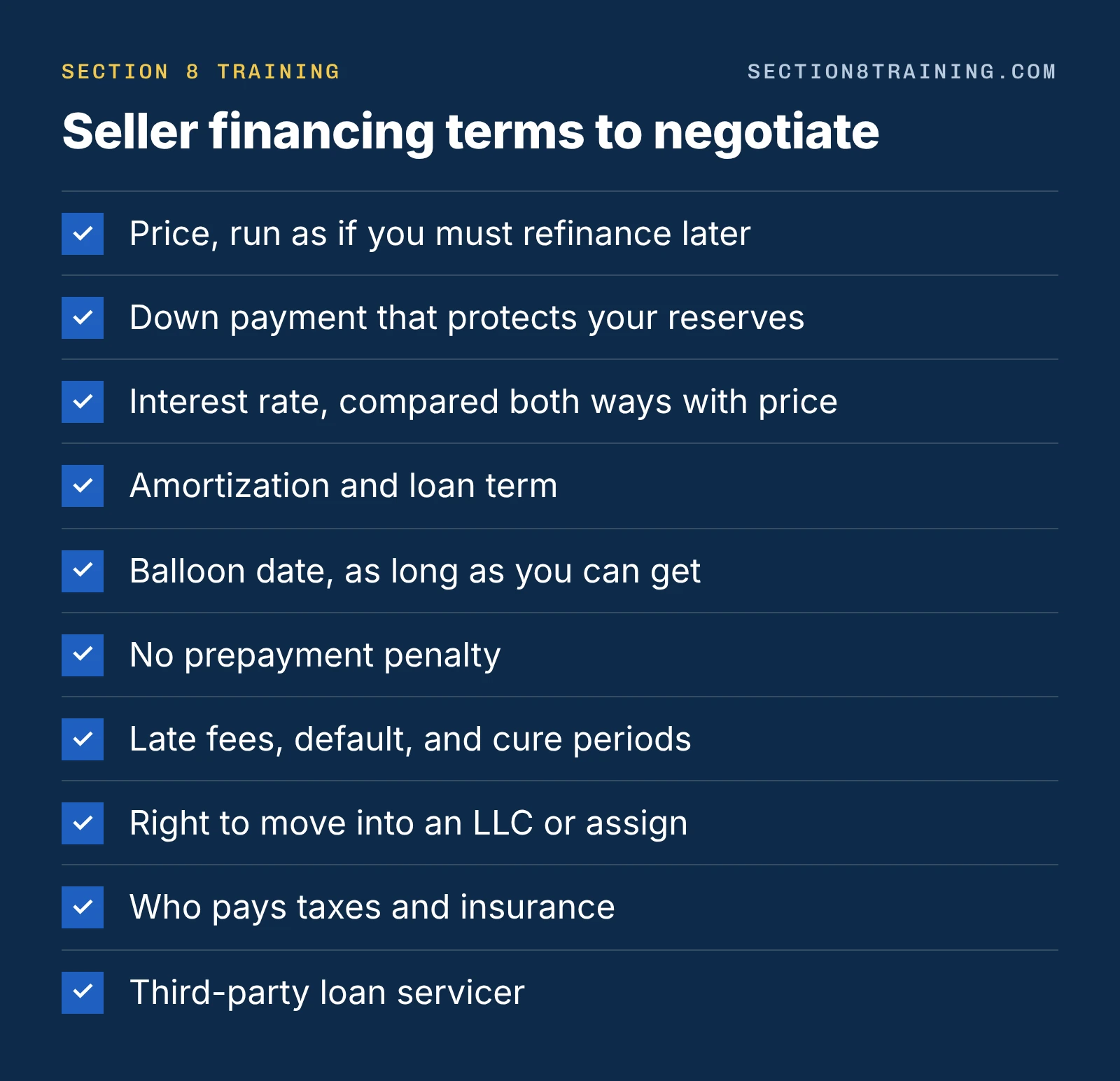
Every term in a seller-financed deal is negotiable. That's the appeal and the danger. Here are the ones that matter most, roughly in order of how much they affect you.
Price
Seller financing often comes with a higher price than a cash sale. That can still be a good deal if the terms are good enough. Just don't let friendly terms hide a bad price. Run the property's numbers as if you had to refinance it at market rates later, because you may have to.
Down payment
There's no legal minimum. Some sellers accept 5% down. Others want 20% or more because a large down payment means you're less likely to walk away. If the seller is flexible on the down payment, use that flexibility to protect your reserves, not to stretch into a property you can't afford to repair.
Interest rate
Sellers can set a rate above or below what banks charge. Very low rates can create tax issues for the seller under IRS rules on below-market loans, so many deals land at or above the applicable federal rate. A lower rate with a higher price can work out better for you than the reverse. Do the math both ways.
Amortization and term
The amortization is the schedule used to calculate the payment, often 20 to 30 years. The term is how long the loan actually lasts before the remaining balance is due. Many seller notes have a 30-year amortization with a 5 to 10 year term, which means a balloon payment.
Balloon payment
If the loan has a balloon, you'll owe the remaining balance on a specific date. Negotiate for as long a term as you can get, and ask for an extension option. More on this below.
Prepayment
Make sure you can pay the loan off early without a penalty. If rates drop or the property's value rises, you'll want to refinance on your schedule.
Late fees, default, and cure periods
Read the default section carefully. How many days late before a late fee? How much notice before the seller can foreclose? Is there a cure period where you can catch up? These details matter most in exactly the moments you hope never happen.
Assignment and transfer
Can you move the property into an LLC later? Can you sell it with the loan in place? Some notes prohibit both. If you plan to hold in an entity, negotiate that up front.
Taxes, insurance, and servicing
Who pays property taxes and insurance, and how does the seller confirm they're paid? Many deals use a third-party loan servicer to collect payments, track the balance, and send year-end tax statements. A servicer protects both sides and costs far less than a dispute.
Balloon payments and due-on-sale risk
Two risks cause most seller financing problems. Both are manageable if you plan for them before you sign.

The balloon payment
A balloon is fine if you can refinance or sell when it comes due. It's a disaster if you can't. Interest rates might be higher. Lending standards might be tighter. The property might need repairs that hurt its appraisal.
Protect yourself by:
- Negotiating the longest term you can. Seven or ten years gives you far more room than three.
- Asking for an extension clause. For example, a one-time 12-month extension for a fee, as long as you're current on payments.
- Building toward refinance from day one. Keep clean records, keep the property in good condition, and track your rental income. Many investors refinance into a DSCR loan, which qualifies the property based on rent, so a solid rent history makes a real difference.
- Running the refinance numbers before you buy. If the deal only works at the seller's low rate and fails at today's bank rates, you're betting the property on future rates.
The due-on-sale clause
Most bank mortgages include a due-on-sale clause. It lets the lender demand full payment if the property is sold or transferred. If a seller still has a mortgage and offers you seller financing anyway, often through a wraparound, their lender could call the loan due after the sale.
That's why the cleanest seller-financed deals involve properties the seller owns free and clear. If the seller still has a loan, you have a few options:
- The seller's lender agrees in writing. Rare, but possible.
- Partial seller financing. You get a new bank loan, pay off the seller's mortgage, and the seller carries a second loan for part of the price. The new bank must approve the second lien.
- A wraparound with full disclosure of the risk. Some investors accept this risk for a short period. If you go this route, understand that the seller's lender could demand payment, and have a plan for that day.
Never accept a deal where someone tells you the due-on-sale clause "never gets enforced." Sometimes it doesn't. You don't want your property to be the exception.
Setting up HAP payments as the new owner
This is the step most seller financing guides leave out, and it's where Section 8 deals differ from ordinary rentals.
The housing agency pays its share of rent, the housing assistance payment, to the property's owner under a HAP contract. To get paid, the agency needs to know you're the owner. How that happens depends on whether a voucher tenant is already living there.
If the property is vacant, you go through the normal process for a new tenancy. A voucher holder applies, you approve them, and the tenant submits a Request for Tenancy Approval to the agency. The agency inspects the unit, approves the rent, and you sign a new HAP contract. You'll provide proof of ownership, a W-9, and direct deposit details. This guide to how the HAP contract works covers the contract itself.
If a voucher tenant is already in place, the existing lease and HAP contract generally carry over to the new owner. You'll submit a change of ownership package to the agency with proof that you own the property. Agencies handle this differently. Los Angeles County's agency, for example, explains that new owners submit a transfer of ownership form with proof of ownership such as a recorded deed, and that the agency may hold the next payment while it processes the change, according to its property ownership changes FAQ. Agree in writing with the seller how any payment that still goes to them after closing will be passed to you.
Here's where the structure matters. If you buy with a promissory note and a recorded deed in your name, you can show the agency a deed, and the process is routine. If you buy on a land contract or a lease option, the seller may still hold title. Some agencies accept a recorded land contract or a management agreement as proof of your right to collect rent. Others don't, and the HAP contract may need to stay in the seller's name until you get the deed.
Before you sign, call the housing agency and ask exactly what proof of ownership it accepts for a seller-financed purchase. Ask for the answer in writing if you can. It's a short phone call that can prevent months of payments going to the wrong person. If you're not sure which agency covers your property, this explainer on what a PHA is shows how to find it.
Running the numbers on a seller-financed Section 8 deal
Seller financing changes your payment, but it doesn't change what the property earns. Here's a simple illustration, using made-up numbers, of how to check a deal.
Say a seller offers a three-bedroom house for $120,000 with $12,000 down and a $108,000 note at 6% interest, amortized over 30 years with a 7-year balloon.
- Monthly principal and interest: about $648
- Contract rent approved by the agency: suppose $1,450, split between the agency's payment and the tenant's share
- Taxes and insurance: suppose $250 a month
- Property management: suppose 10% of rent, $145
- Repairs, capital expenses, and vacancy reserve: suppose $220
That leaves roughly $187 a month before any surprises. That might be acceptable, or it might be too thin for your goals. The point is to run it with realistic expenses instead of just comparing the payment to the rent.
Then run the refinance test. In year seven, the remaining balance is roughly $97,000. If you refinance that at a higher rate, does the property still cash flow? If not, the deal depends on rates or values moving in your favor.
Use the actual approved rent, not a guess. The rent the agency will approve depends on the local payment standard, the utility allowance, and rent reasonableness. This breakdown of the numbers nobody shows you before you buy a Section 8 rental walks through every line, and this guide to Section 8 cash flow explains where the money actually comes from.
Paperwork and attorney review
Seller financing is legal in every state, but the rules, documents, and default procedures vary. This isn't a deal to do with a downloaded template.
At minimum, a seller-financed purchase usually involves:
- A purchase agreement that spells out the financing terms
- A promissory note with the amount, rate, payment schedule, balloon date, and default terms
- A mortgage or deed of trust that secures the note and gets recorded
- A title search and title insurance, so you know about existing liens and judgments
- A recorded deed in your name, unless you're using a land contract
- A loan servicing agreement, if you use a servicer
Hire a local real estate attorney to review or draft the documents. Federal and state lending rules can apply to seller-financed sales, especially when the buyer will live in the home. Investor purchases are often treated differently, but your attorney should confirm what applies in your state. Use a title company or attorney to close, just as you would with a bank loan, and get an inspection before you sign, because seller financing doesn't make a bad roof any cheaper to replace.
When seller financing makes sense, and when it doesn't
Seller financing is a tool, not a strategy. It makes sense when:
- The property works on its own numbers at a realistic rent
- The seller owns it free and clear, or the existing loan is handled properly
- The term is long enough that you aren't betting on next year's rates
- You can show the housing agency you're the owner
- You still have cash reserves after the down payment
Walk away when:
- The deal only works because the payment is low, not because the property is good
- The balloon comes due in two or three years with no extension
- The seller still has a mortgage and nobody wants to talk about due-on-sale
- The contract gives the seller fast forfeiture rights and gives you little protection
- You'd have no money left for repairs after closing
Seller financing can be a real path into Section 8 investing with less money down. It works best for investors who understand the property first and the financing second. If you're comparing it with other low-down-payment approaches, our guide to buying rentals with under $15K down covers the alternatives, and how to finance your first Section 8 rental compares conventional, DSCR, and other loan types. For a founder's perspective on what early deals teach, read the lessons Karim Naoum learned the hard way in real estate.
Seller financing questions investors ask
Can I use seller financing with no money down?
Occasionally, but it's rare and risky. A seller who accepts nothing down has little protection, so they often make up for it with a higher price or rate. You'd also start with no equity and no cushion for repairs. A modest down payment usually gets you better terms and a safer deal.
Does the housing agency care how I financed the property?
Not directly. The agency cares that you're the owner, that the unit passes inspection, and that the rent is reasonable. Financing matters only because it affects how you prove ownership, which is why a recorded deed in your name makes the process smoother.
Will seller financing show up on my credit report?
Usually not, unless the seller or servicer reports it. That can help if you're trying to keep room for conventional loans, but it also means on-time payments won't build your credit. Ask your servicer.
Can I refinance a seller-financed property later?
Yes, and many investors plan to. Lenders will look at the property's value, your payment history on the note, and, for DSCR loans, the rent. Keep a clean record of every payment and every rent deposit from the agency.
What happens if the seller dies before the note is paid off?
The note becomes part of their estate, and you keep paying their heirs or estate under the same terms. A recorded note and a third-party servicer make this much simpler for everyone.
Get your first seller-financed deal reviewed
Creative financing is where experienced eyes help most. The difference between a good seller-financed deal and a trap is usually in the terms: the balloon date, the default clause, and whether the housing agency will recognize you as the owner.
Section 8 Training works with investors who have $15,000 or more ready to deploy and want help structuring deals, analyzing properties, and working through the agency process. If you're looking at seller financing, or just want to know whether it fits your situation, apply and book a strategy call. It's a straight 30-minute conversation about your capital, your market, and your next step.


