



If you've spent any time researching Section 8 investing, someone has probably pitched you a turnkey rental. The offer sounds clean: a renovated house in an affordable market, a voucher tenant already placed or lined up, a property manager ready to go, and a projected monthly return. You wire the down payment, sign the papers, and collect rent from wherever you live.
For some investors, turnkey Section 8 properties are a reasonable way to get started. For others, they're an expensive way to buy a house at retail price with a management contract that's hard to leave.
This guide explains what turnkey sellers actually sell, how their pricing works, where the conflicts of interest sit, and the questions to ask before you buy one. It also compares turnkey with buying and setting up a property yourself, so you can decide which trade-off fits you.
What turnkey means
A turnkey property is a rental that's been bought, renovated, and prepared for tenants by a company that then sells it to an investor. "Turnkey" means you could, in theory, just turn the key and start collecting rent.
In the Section 8 world, a turnkey package usually includes some combination of:
- A renovated single-family home or small multifamily in a lower-priced market
- A voucher tenant already placed, or a promise to place one after closing
- A passed housing agency inspection, or one scheduled
- In-house or partner property management
- Pro forma numbers showing expected rent, expenses, and return
- Sometimes, a lender referral and a rent guarantee for a limited period
The company might be a local operator selling its own renovations, a national turnkey brand that partners with local teams, or a wholesaler who calls a lightly updated house "turnkey." The label doesn't tell you which one you're dealing with. You have to ask.
How turnkey pricing works
Turnkey companies make money the same way any business does: they buy low, add value, and sell at a margin. There's nothing wrong with that. The question is whether the value they add is worth what you pay for it.
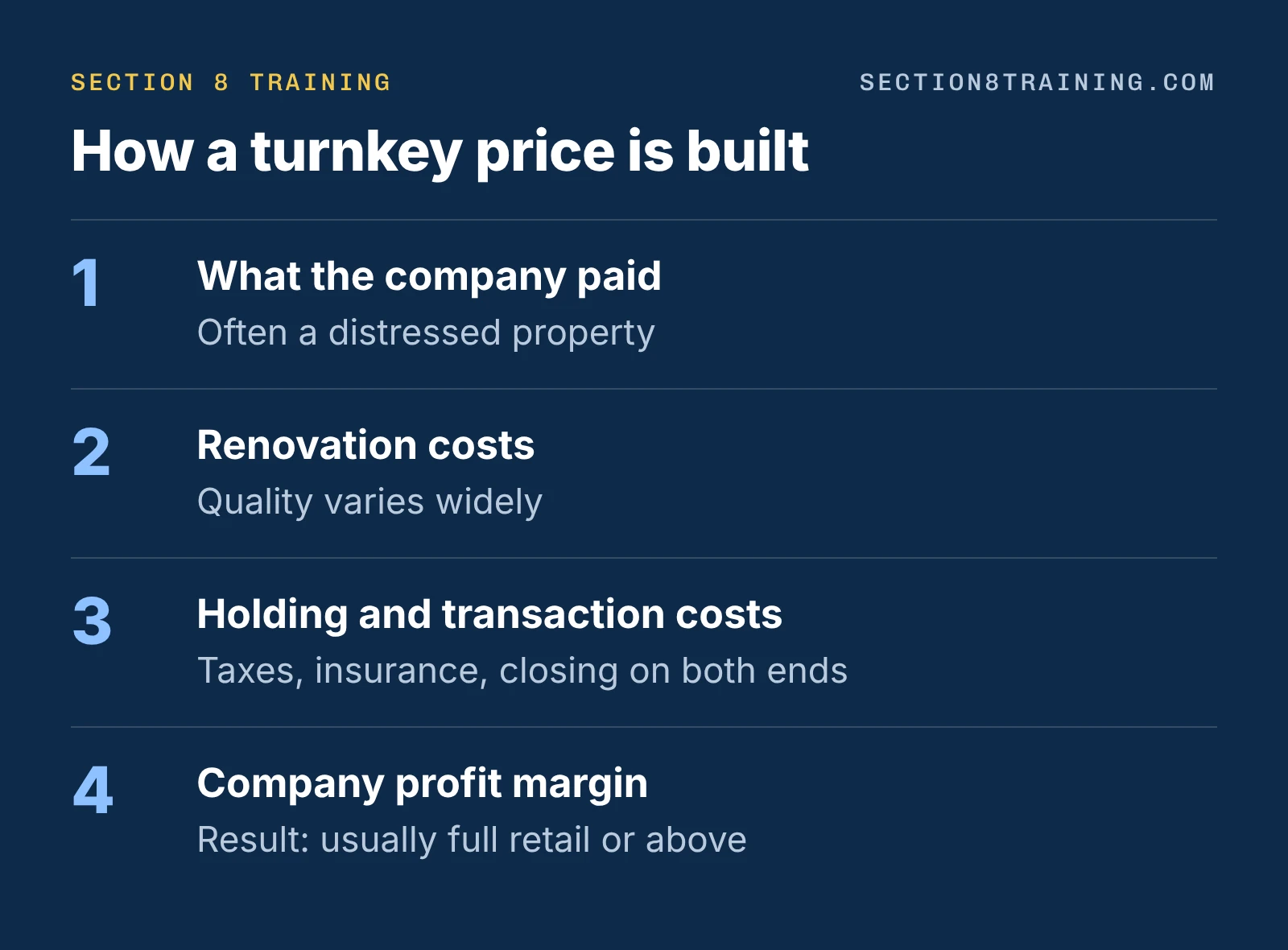
A typical turnkey price is built from:
- What the company paid for the distressed property
- Renovation costs, which vary widely in quality
- Holding and transaction costs, such as taxes, insurance, and closing costs on both ends
- The company's profit margin
The result is usually priced at or near full retail value for a renovated house, and sometimes above what comparable homes sell for. That's the core trade-off. You're paying a premium for the work you didn't have to do and the time you didn't have to spend.
That premium affects you in two ways:
- Lower returns. If you pay more for the same rent, your cash flow and return on cash are lower than if you'd bought and renovated it yourself.
- Less equity on day one. If you paid full retail or more, you won't have the built-in equity that comes from buying below market and fixing it up. That matters if you plan to refinance later.
How to check the price
Don't rely on the seller's appraisal or their comparables. Ask an independent local agent to pull recent sales of similar renovated homes nearby. Compare price per square foot, not just total price. If the turnkey price is well above what similar homes sold for, you're paying for something, and you should know what.
Check the rent too. The rent a housing agency will approve depends on local payment standards, the utility allowance, and rent reasonableness, not on what the seller's spreadsheet says. You can look up Fair Market Rents for any area on HUD USER, and this guide to how Fair Market Rent works explains how agencies turn those numbers into payment standards.
Management agreements and conflicts
This is the part of turnkey investing that deserves the most attention, and it's the part buyers read least.
Many turnkey companies sell the property and manage it afterward. That can be convenient, because the people who renovated the house know it best. It also creates conflicts of interest worth understanding.
Repair conflicts. If the manager also does the repairs, they earn more when more repairs happen. Look for markups on maintenance work and whether you can use outside contractors.
Quality conflicts. If the renovation was rushed, problems often show up in the first year or two. The company that did the work is the same one deciding whether a problem is "normal wear" or a warranty issue.
Exit conflicts. Some management agreements are hard to leave. Look for long terms, cancellation fees, or clauses that tie the warranty or rent guarantee to keeping their management.
Reporting conflicts. A manager who also sold you the property has an incentive to make the numbers look good. Insist on detailed monthly statements, including the housing agency's payment, the tenant's share, and every expense.
Before you sign, read the management agreement as carefully as the purchase contract. Get the fee schedule in writing, including leasing fees, renewal fees, maintenance markups, and inspection fees. If you want to understand what a good Section 8 manager should actually be doing, this guide to Section 8 landlord responsibilities lays it out.
Questions to ask a turnkey seller
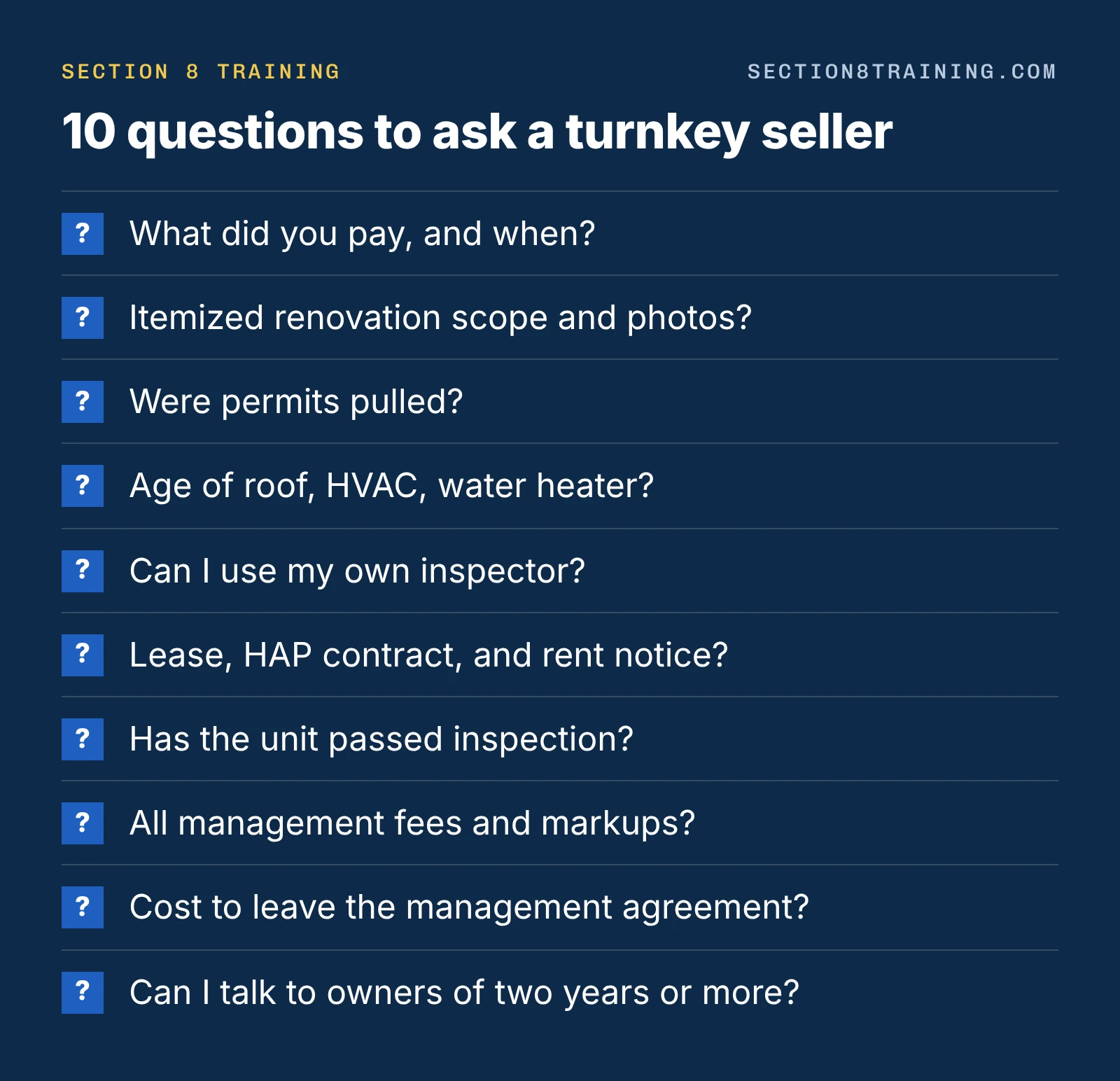
Ask these before you make an offer. A good turnkey company will answer them clearly. A company that dodges them is telling you something.
About the property
- What did you pay for this house, and when?
- What exactly did you renovate? Can I see an itemized scope and before-and-after photos?
- Were permits pulled for the work?
- How old are the roof, HVAC, water heater, plumbing, and electrical?
- Will you allow my own independent inspection before closing?
About the tenant and the rent
- Is a voucher tenant in place? If so, can I see the lease, the HAP contract, and the most recent rent notice from the agency?
- If not, how long does it usually take you to place a voucher tenant in this area?
- Is the projected rent the agency's approved contract rent, or an estimate?
- Has the unit passed the housing agency's inspection? Can I see the report?
About management and guarantees
- What are all of your management fees, and do you mark up repairs?
- How long is the management agreement, and what does it cost to leave?
- Is there a rent guarantee? What exactly does it cover, for how long, and what voids it?
- Is there a renovation warranty? Does it depend on staying with your management?
About the numbers
- What vacancy, repair, and capital expense reserves are in your pro forma?
- Can I talk to two or three investors who've owned your properties for at least two years?
That last question matters most. Projected numbers are easy. Owners who've lived with a company's renovations, tenants, and management for a few years can tell you what actually happened.
Turnkey vs buying it yourself
Here's how the two approaches usually compare:
- Purchase price. Turnkey: Retail or above; Buy and set up yourself: Can be below market if you buy distressed.
- Your time. Turnkey: Low; Buy and set up yourself: Higher, especially on the first deal.
- Renovation risk. Turnkey: On the seller, until it isn't; Buy and set up yourself: On you.
- Equity at purchase. Turnkey: Usually little; Buy and set up yourself: Can be meaningful.
- Control over manager. Turnkey: Often limited; Buy and set up yourself: Full.
- Learning. Turnkey: Less, unless you dig in; Buy and set up yourself: More, by necessity.
- Best for. Turnkey: Busy investors who value speed; Buy and set up yourself: Investors willing to build a team.
Buying it yourself doesn't mean doing the work yourself. Many investors buy a property that needs work, hire a local contractor, and use an independent property manager. That's more coordination than turnkey, but it usually means a lower price, more equity, and a manager who works only for you. If you're weighing a structured program against doing it on your own, this comparison of Section 8 Training vs DIY lays out the trade-offs.
When turnkey makes sense
Turnkey isn't automatically a bad deal. It can make sense when:
- Your time is worth more than the premium. If you have a demanding career and limited hours, paying more to skip the renovation can be a rational trade.
- The price is close to true market value. Some turnkey operators price fairly. Independent comps will tell you.
- The management is good and you can leave. A manager you'd keep anyway, with a reasonable exit clause, removes the biggest risk.
- The numbers still work without the guarantee. If the deal only works because of a 12-month rent guarantee, it doesn't really work.
- You still do your own due diligence. Independent inspection, independent comps, and your own rent check.
It makes less sense when the price is well above comparable sales, you can't use your own inspector, the management contract locks you in, or the seller's projections assume no vacancy and minimal repairs.
Running your own numbers
Whatever you buy, turnkey or not, run the numbers yourself with realistic expenses: taxes, insurance, management, repairs, capital expenses, vacancy, and reserves. Compare the result with the seller's projection. If they differ, find out why.
This breakdown of the numbers nobody shows you before you buy a Section 8 rental walks through every line a turnkey pro forma tends to leave out, and this guide to the real cost of a Section 8 deal shows what it actually takes to get a property rent-ready.
Learn the process before you pay for a shortcut
Turnkey promises to save you from the learning curve. The catch is that the learning curve is what helps you spot an overpriced deal, a weak renovation, or a management contract that doesn't serve you.
Section 8 Training is built for investors who want to understand the process well enough to make those calls themselves, whether they buy turnkey, distressed, or tenant-occupied. The program includes group deal review, and the Inner Circle and Legacy tiers add one-on-one coaching. It's designed for people with $15,000 or more ready to invest. If you're weighing a turnkey offer right now, apply and book a strategy call. It's a 30-minute conversation about your capital, your goals, and whether the deal in front of you makes sense.


