



A lot of landlords reach the same point. They bought a rental years ago in a market that has since gone up a lot. The property is worth far more than they paid, but the rent hasn't kept pace with the value. On paper, they're doing well. In their bank account, the monthly cash flow is modest for how much equity is sitting in the house.
Selling and buying something that produces more income sounds simple until the tax bill shows up. Capital gains tax, plus tax on the depreciation you've claimed over the years, can take a big bite out of the money you'd reinvest.
A 1031 exchange is how many investors solve that. It lets you sell an investment property and reinvest the proceeds into other investment real estate while deferring the tax. For landlords who want to shift from appreciation toward cash flow, a 1031 exchange into Section 8 rentals can turn one high-value, low-yield property into several income-producing ones.
This guide explains how it works, the 45-day and 180-day deadlines, what counts as like-kind, how to exchange one property for several, the role of the qualified intermediary, and the risks that are specific to buying Section 8 rentals on a deadline.
It's general information, not tax or legal advice. A 1031 exchange has strict rules, and mistakes can make the whole gain taxable. Work with a CPA and a qualified intermediary before you list your property.
What a 1031 exchange does
Section 1031 of the Internal Revenue Code lets you defer capital gains tax when you exchange real property held for investment or business use for other real property held for the same purpose. The IRS summarizes the basics in its guide to like-kind exchanges.
A few key points:
- It's a deferral, not a forgiveness. The tax doesn't disappear. Your old property's tax basis carries into the new properties, so the deferred gain is still there if you sell later without exchanging again.
- It applies to investment and business real estate. Your primary residence doesn't qualify. Neither does property you hold mainly to resell, like a flip.
- You must reinvest through a qualified intermediary. You can't take the sale money yourself, even briefly.
- To defer all the tax, you generally need to buy equal or greater value and reinvest all the cash. Any cash you keep, or any reduction in debt you don't replace, can be taxable. This is called boot.
Some investors exchange again and again over decades, moving into larger or better-performing properties each time without paying tax along the way. How deferred gains are treated when an owner passes away is a question for your estate planning attorney and CPA, because it depends on current law and your situation.
The 45 and 180 day deadlines
The deadlines are where most exchanges succeed or fail. They're strict, they run at the same time, and they generally aren't extended for weekends, holidays, or a seller who drags their feet.
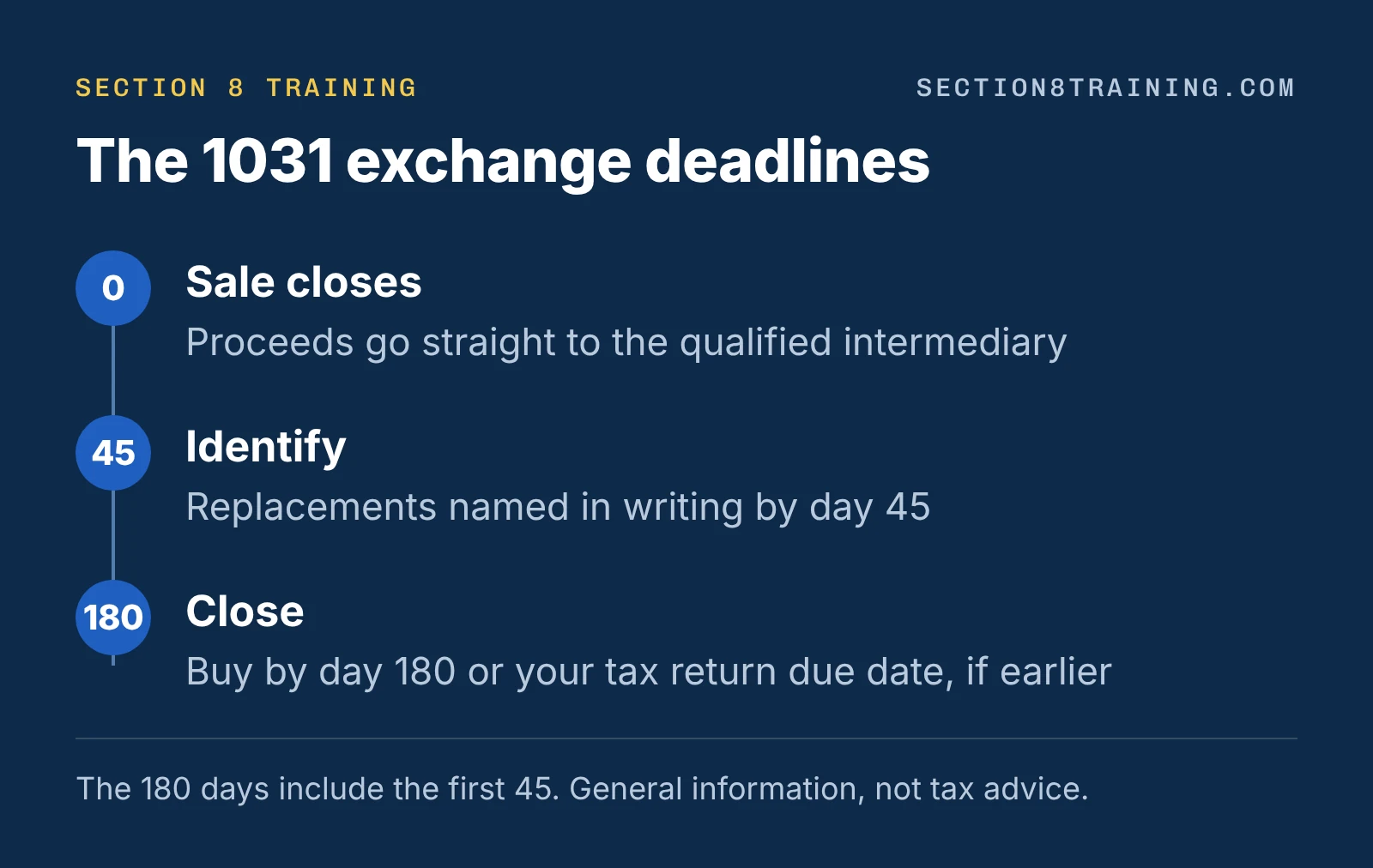
The 45-day identification period. Starting the day your old property closes, you have 45 calendar days to identify potential replacement properties in writing to your qualified intermediary. The identification has to be specific, typically the street address.
The 180-day exchange period. You must close on your replacement properties within 180 calendar days of selling the old one, or by the due date of your tax return for that year, including extensions, if that's earlier. The 180 days include the first 45. They don't start after it.
That second point trips people up. If you sell in late fall, your tax return deadline could come before day 180 unless you file an extension. Ask your CPA about this before you close.
Identification rules
You can't identify unlimited properties. The most common approaches are:
- The three-property rule. Identify up to three properties of any value.
- The 200% rule. Identify any number of properties, as long as their total value doesn't exceed 200% of the value of the property you sold.
There are other options, but these two cover most small investors. If you're planning to buy several Section 8 properties, the 200% rule often gives you more room, since you'll want backups in case a deal falls through.
Like-kind rules for rentals
"Like-kind" sounds narrow, but for real estate it's broad. Since 2018, only real property qualifies for 1031 treatment, and almost any investment real estate is like-kind to any other investment real estate in the US.
That means you can exchange:
- A single-family rental for several single-family Section 8 rentals
- A small apartment building for a group of houses
- Raw land held for investment for rental homes
- A property in an expensive coastal market for properties in lower-priced markets in another state
You can't exchange US real estate for property outside the US, and you can't exchange into a property you plan to live in as your main home.
The same taxpayer that sold the old property generally needs to buy the new ones. If you sold in your own name, buy in your own name or through a single-member LLC that's disregarded for tax purposes. Changing the owner partway through, such as selling as an individual and buying through a multi-member partnership, can break the exchange. Plan the ownership structure before you sell. Our guide on whether to own a Section 8 rental in an LLC covers the trade-offs.
Swapping one property for several
This is where a 1031 exchange fits Section 8 investing especially well.
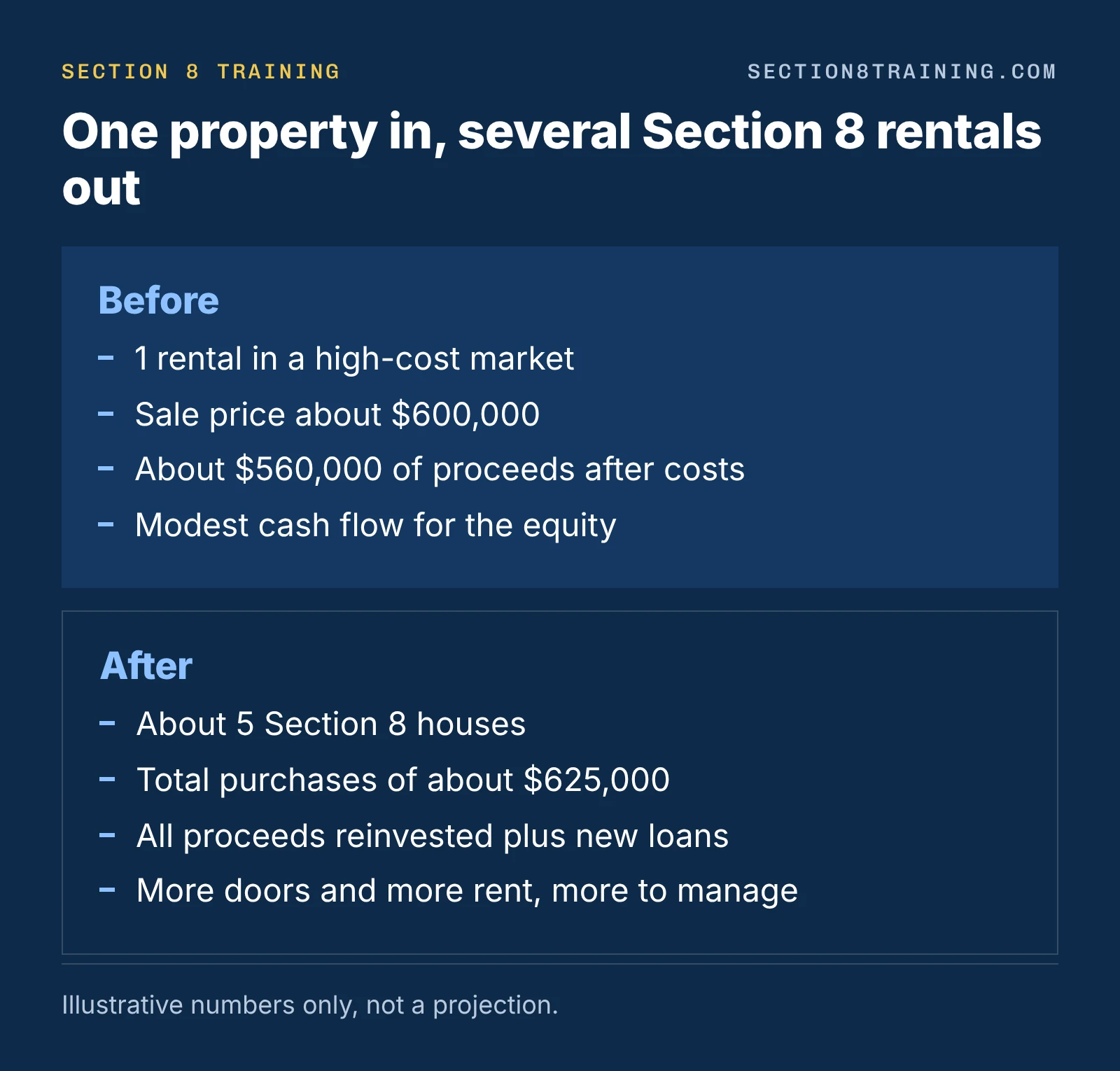
Say you own a rental in a high-cost market worth $600,000. It's paid down, rents for $2,800 a month, and after taxes, insurance, and repairs it produces modest income for that much equity. Section 8 rentals in many Midwest and Southern markets cost a fraction of that.
Using simple, illustrative numbers that aren't a projection: you sell the $600,000 property and, after selling costs, have about $560,000 of proceeds held by your intermediary. To defer the full gain, you'd buy at least as much property as you sold, and reinvest all the proceeds. You might use the proceeds as down payments on four to six Section 8 houses, adding new financing so that the total purchase price meets or exceeds what you sold.
The result is more doors, more rent spread across more properties, and potentially more cash flow, though also more properties to manage, more inspections, and more moving parts. Whether that trade makes sense depends on your goals. Our comparison of Section 8 vs traditional rentals lays out how the two models differ day to day.
Replacing the debt
If your old property had a mortgage, you generally need to replace that debt on the new properties, either with new loans or by adding cash. Paying off a $200,000 mortgage on the sale and buying replacements with less total debt can create taxable boot, even if you reinvest every dollar of cash. Your CPA can run the numbers before you list.
Qualified intermediaries
A qualified intermediary, sometimes called an exchange accommodator, is the independent party that holds your sale proceeds and uses them to buy your replacement properties. Their role is required. If the money touches your bank account, the exchange generally fails.
The intermediary usually:
- Prepares the exchange agreement, which you sign before your sale closes
- Receives the sale proceeds directly from the closing
- Receives your written identification of replacement properties
- Sends funds to the closings on your replacement properties
- Provides documentation for your tax return
You'll report the exchange on IRS Form 8824. The Form 8824 instructions explain what's required.
Choosing an intermediary matters. They're holding a large amount of your money for up to six months. Ask how funds are held and protected, whether they carry insurance or bonding, and how long they've been doing exchanges. People who have recently worked for you, such as your real estate agent, attorney, or accountant, generally can't serve as your intermediary, so ask before you pick someone.
Risks specific to exchanging into Section 8
A 1031 exchange works the same way whether you buy Section 8 rentals or any other property. But a few risks are sharper when you're buying voucher rentals on a deadline.
The 45-day squeeze. Finding several good Section 8 properties, in a market you may not know well, in six weeks, is hard. Start looking before you list your property, and line up your agent, lender, and property manager in advance.
Inspection and lease-up time. A vacant property has to pass the housing agency's inspection and lease to a voucher tenant before rent starts. That process takes weeks to months. Your exchange can close on time while the properties sit empty, so plan reserves for the gap. Tenant-occupied replacements can help, but they come with their own due diligence, covered in our guide to buying a house with a Section 8 tenant already in place.
Overpaying under pressure. Deadlines make people say yes to deals they'd normally pass on. A bad property bought to save taxes is still a bad property. Identify backups so you're never stuck with one option.
Financing timelines. If you need loans on several replacement properties, each one has its own underwriting and appraisal. Start with a lender who understands both exchanges and Section 8 rents.
Management capacity. Going from one property to five or six is a different business. Line up a manager who knows the voucher program before you close, not after. Before you start, read this look at Section 8 investing risks so you go in with clear expectations.
When not to do a 1031 exchange
A 1031 exchange isn't always the right move.
- Your gain is small. If the tax you'd defer is modest, the cost, complexity, and deadline pressure may not be worth it.
- You want the cash. If you need money for something other than real estate, an exchange defeats the purpose.
- You can't find good replacements in time. Paying the tax is better than buying properties you don't want.
- You're done being a landlord. If you don't want to manage more properties, other options may fit better. Your advisor can walk you through them.
- Your timing doesn't work. If you can't line up replacement properties and financing within the deadlines, consider waiting to sell.
Quick answers on 1031 exchanges into Section 8
Can I exchange a rental in one state for Section 8 properties in another?
Yes. Any US investment real estate is generally like-kind to any other US investment real estate, regardless of state.
Do the replacement properties need tenants before the exchange closes?
No. The exchange depends on buying qualifying property on time, not on it being leased. Vacant properties still need inspection and lease-up before rent starts, so budget reserves.
Can I take some cash out?
Yes, but any cash you keep is generally taxable. Some investors accept that trade for flexibility.
A different kind of next chapter
For experienced landlords, a 1031 exchange into Section 8 rentals is often less about taxes and more about changing what your portfolio does for you, moving from equity that sits still toward income that arrives every month. That shift comes with its own learning curve. Experienced owners adding voucher tenants for the first time will find this practical guide useful: what experienced landlords should know before adding Section 8.
Plan your exchange before you list
The most important part of a 1031 exchange into Section 8 rentals happens before you sell: choosing a market, lining up a team, and knowing which properties you'll likely identify on day one.
Section 8 Training works with investors who have $15,000 or more ready to deploy, including experienced landlords repositioning their portfolios. The program covers market selection, deal analysis, financing, and working with housing agencies, with one-on-one coaching in the Inner Circle and Legacy tiers. If you're considering an exchange, apply and book a strategy call. It's a 30-minute conversation about your current property, your goals, and whether Section 8 rentals fit the next chapter.


