



"Always use an LLC" might be the most repeated advice in real estate investing. You'll hear it on podcasts, in forums, and from friends who own one rental. For a new Section 8 investor, it raises a fair question: do you really need one before your first deal, and what changes if you use one?
The honest answer is that an LLC can help, it isn't magic, and it has costs and side effects that most advice skips. For Section 8 investors in particular, an LLC affects your financing options and the paperwork you file with the housing agency, not just your liability.
This guide covers what an LLC does and doesn't protect, how it changes financing, how it interacts with the HAP contract and your tax forms, why insurance still matters, what it costs to keep one, and the questions to bring to your attorney and CPA.
It's general information, not legal or tax advice. LLC rules vary by state, and the right structure depends on your situation.
What an LLC does and doesn't protect
A limited liability company is a separate legal entity. When an LLC owns your rental, claims that arise from the property are generally claims against the LLC, not against you personally. If a tenant's guest is injured and sues, the LLC's assets are at risk. Your house, savings, and other investments generally aren't, as long as the LLC has been run properly.
That protection has limits worth understanding.
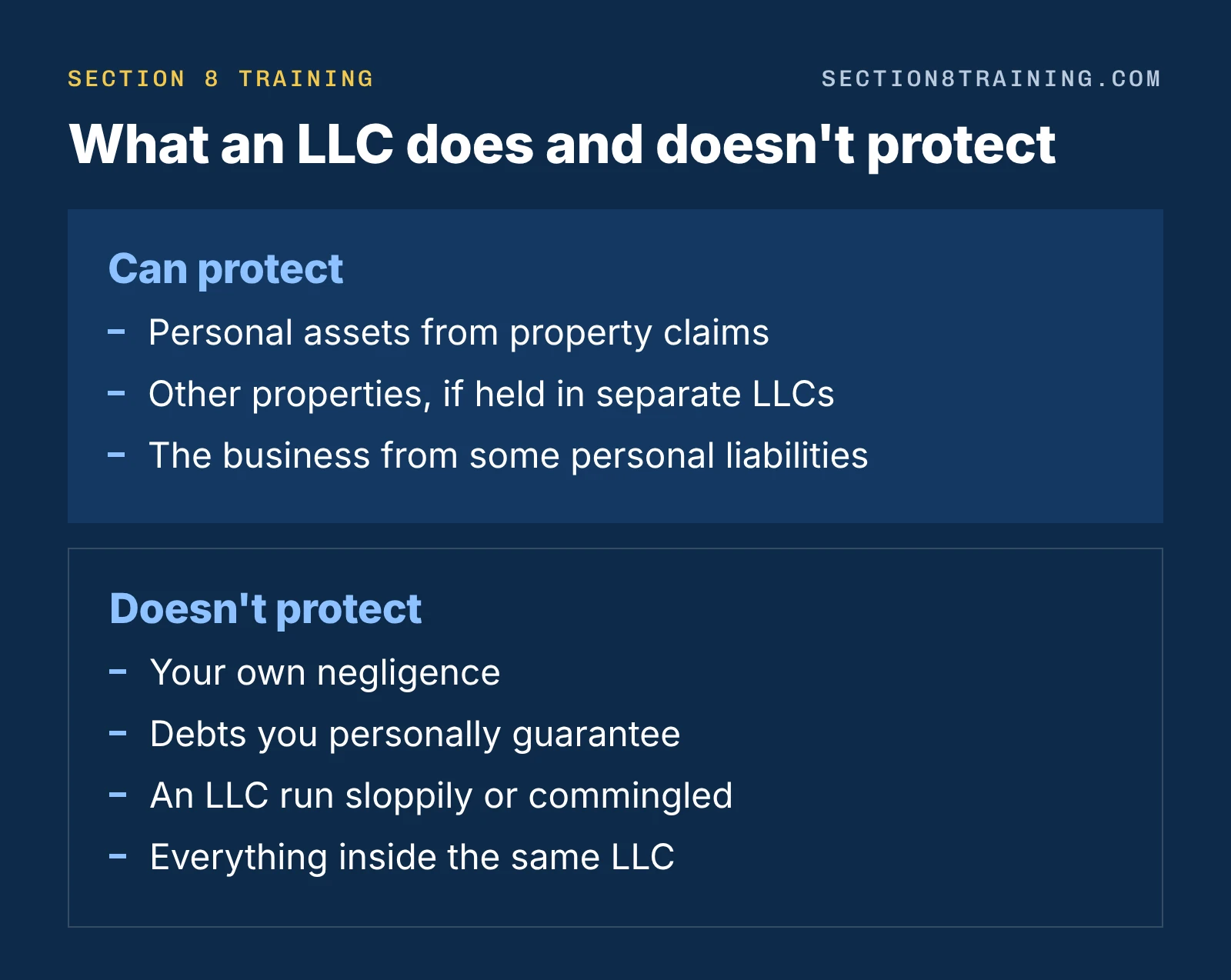
What an LLC can protect:
- Your personal assets from claims arising out of the property
- Your other properties, if each one is held in a separate LLC
- Your rental business from some of your personal liabilities, depending on your state's rules
What an LLC doesn't protect:
- Your own negligence. If you personally do something careless, such as a repair you do yourself that causes an injury, you may still be personally liable.
- Personal guarantees. If you personally guarantee the LLC's mortgage, which most lenders require, you're on the hook for that debt.
- A sloppy LLC. If you mix personal and LLC money, sign leases in your own name, or skip basic formalities, a court may disregard the LLC and reach your personal assets. This is called piercing the corporate veil.
- Everything inside the LLC. If one LLC holds five properties, a claim against one property can reach all five.
An LLC is one layer of protection. Insurance is another, and for most small landlords, it's the one that actually pays when something goes wrong.
Financing in an LLC
This is where many first-time investors get surprised.
Conventional loans are usually made to individuals. Most conventional mortgages backed by Fannie Mae and Freddie Mac are made to you personally, not to an LLC. If you want those rates and terms, which are often the best available to a W-2 earner, you'll typically buy in your own name.
DSCR and portfolio loans often lend to LLCs. Many investor loans, including DSCR loans that qualify the property based on rent, are designed to lend to an LLC. Some require it. They'll still usually ask for a personal guarantee.
Moving a financed property into an LLC later can trigger the due-on-sale clause. Most mortgages let the lender demand full payment if the property is transferred. Some lenders allow transfers to an LLC you control. Others don't. Before you deed a mortgaged property into an LLC, ask your lender or servicer in writing.
Title insurance can be affected too. Your owner's title policy is issued to whoever bought the property. If you transfer the property to an LLC later, ask your title company whether coverage continues or whether you need an endorsement.
The practical result is that many investors buy their first one or two properties in their own name with conventional financing, then use an LLC for later purchases with DSCR loans. Others start in an LLC from day one and accept the higher rate. Neither is wrong. Our guide to how to finance your first Section 8 rental compares the loan types in more detail. If you're buying with seller financing, check whether the note allows the property to be held in an LLC, which we cover in seller financing a Section 8 property.
LLCs, the HAP contract, and your W-9
This is the part that's specific to Section 8, and it rarely comes up in general LLC advice.
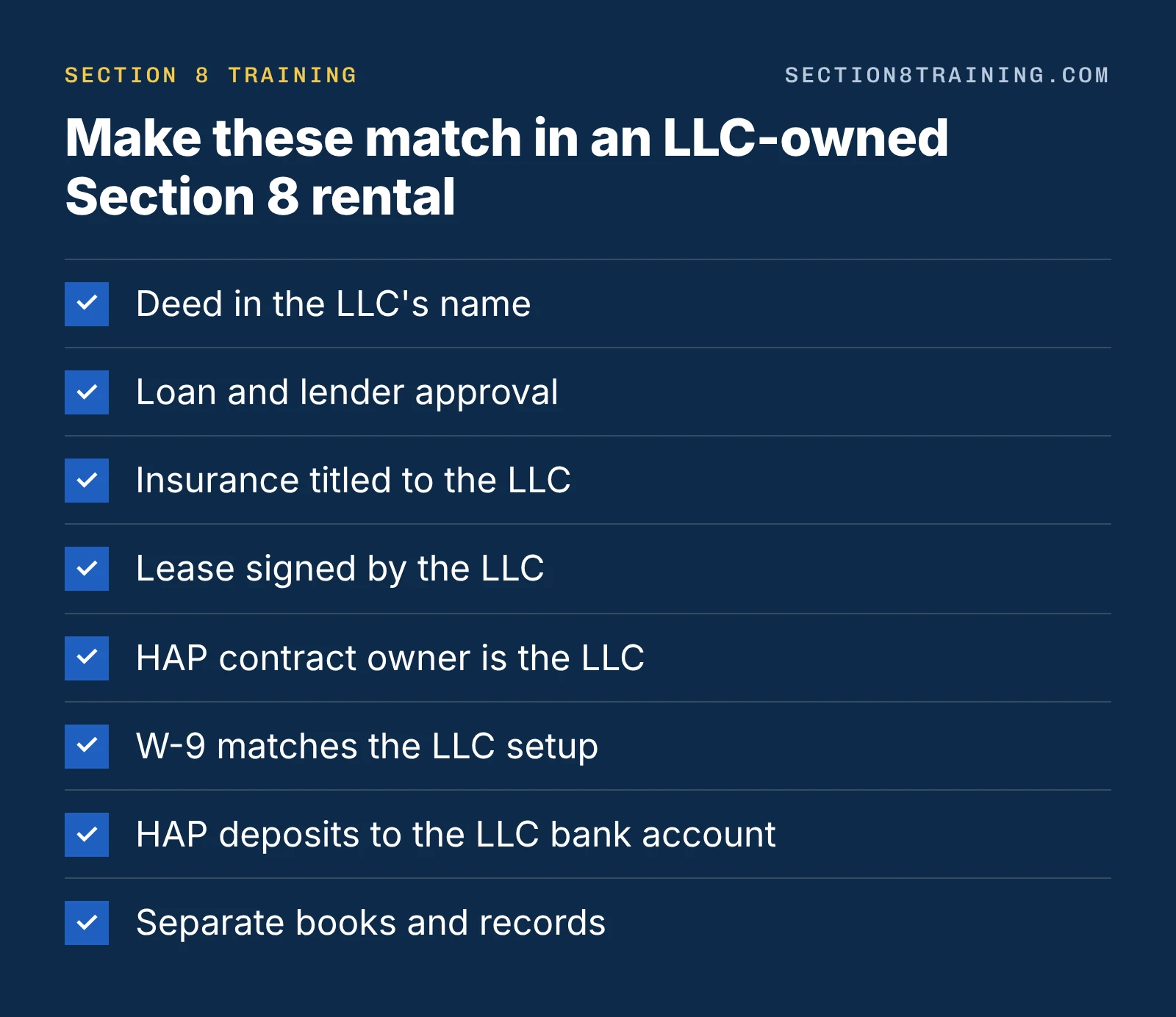
The housing agency pays its share of rent to the owner named on the HAP contract. The agency will ask for a tax form, typically a W-9, and the name and taxpayer number on that form need to match the owner on the contract and the deed.
That has a few practical effects:
- If the LLC owns the property, the LLC should be the owner on the HAP contract and the lease. Sign documents as a member or manager of the LLC, not in your personal name.
- Your W-9 should match how the LLC is set up for tax purposes. A single-member LLC is often treated as a disregarded entity for income tax, which affects which name and number go on the form. Your CPA can tell you exactly what to enter.
- Changing ownership after lease-up means agency paperwork. If you buy in your own name, sign a HAP contract, and then transfer the property to an LLC, the agency will generally treat it as a change of ownership. That usually means submitting proof of the new ownership, a new tax form, and new banking details. Payments may be held while the agency processes it. Los Angeles County's agency, for example, describes this process in its property ownership changes FAQ.
- The bank account should belong to the LLC. HAP payments for an LLC-owned property should go into the LLC's account. Depositing them into your personal account is exactly the kind of commingling that weakens LLC protection.
If you're going to use an LLC, it's simpler to form it before you buy and before you register with the agency. Moving things later is possible, but it creates more paperwork and possible payment delays. If you're not sure who your agency is or how to contact them, this explainer on what a PHA is helps, and this guide to the HAP contract explains what you're signing.
Insurance still matters
An LLC limits what can be taken from you. Insurance pays the claim. For most small landlords, the second one matters more day to day.
At minimum, Section 8 investors usually carry:
- A landlord or dwelling policy on each property, with liability coverage, issued to the owner, which should be the LLC if the LLC holds title
- An umbrella policy that adds liability coverage above your landlord policies
- Flood or other specialty coverage where the property's location calls for it
Some investors with one or two properties decide that good insurance, including a solid umbrella policy, gives them enough protection for now, and they form an LLC later. Others want both from the start. Talk to an insurance agent who works with landlords and ask how your policies should be titled if you use an LLC.
Costs and upkeep
An LLC isn't free to form or keep. Costs vary a lot by state.
- Formation fees paid to the state when you file
- Annual or biennial report fees, and in some states, a minimum annual franchise tax. California, for example, charges at least $800 a year
- Registered agent fees, if you use a service
- Extra tax preparation, especially for multi-member LLCs that file partnership returns
- Separate bank accounts and bookkeeping
- Higher loan rates, if the LLC pushes you from conventional into DSCR financing
If you buy property in a different state from where you live, you may need to register the LLC in the property's state as well, which can mean two sets of fees.
None of these costs are huge on their own. Together, on a single property with thin cash flow, they can matter. Run them through your deal analysis like any other expense.
Setting up a Section 8 rental LLC: one or several?
Investors with multiple properties often ask whether to use one LLC for everything or one per property.
- One LLC for everything is simpler and cheaper, but a claim against one property can reach all of them.
- One LLC per property isolates risk but multiplies fees, bank accounts, and tax filings.
- Some states allow series LLCs, which create separate series under one LLC. Rules and recognition vary, and lenders and housing agencies may be less familiar with them.
Many investors start with one LLC and add more as the portfolio grows. That's a conversation for your attorney once you have a few properties.
Questions for your attorney and CPA
Bring these to your first meeting:
- In my state, how much protection does an LLC actually give a residential landlord?
- Should I form the LLC in my home state, the property's state, or both?
- If I buy in my own name now, what would it take to move the property into an LLC later?
- How should I fill out the W-9 for the housing agency?
- What formalities do I need to follow so the LLC holds up if I'm sued?
- Single-member or multi-member? How does that change my taxes?
- What will this cost each year in fees and tax preparation?
- How should my insurance policies be titled?
If you're investing from outside the US, the answers can change significantly, especially for Canadian residents. Our guide to Section 8 investing for foreign investors covers the extra considerations.
So, should you buy your Section 8 rental in an LLC?
An LLC usually makes sense when you have meaningful personal assets to protect, you're financing with a loan that lends to LLCs anyway, or you're building a portfolio of several properties.
Owning in your own name can make sense for a first property when conventional financing gives you much better terms, you carry strong landlord and umbrella insurance, and you plan to revisit the structure as you grow.
What doesn't make sense is skipping the conversation entirely. Decide before you buy, set it up properly, and make sure your deed, loan, insurance, lease, HAP contract, W-9, and bank account all match. If you'd like a broader view of what can go wrong in Section 8 investing, this look at Section 8 investing risks is a good companion read.
Set up your first deal the right way
Structure is easier to get right before you buy than to fix afterward. Section 8 Training helps investors with $15,000 or more ready to invest plan their first deals, including financing, ownership structure, and the housing agency process. If you're deciding how to hold your first Section 8 rental, apply and book a strategy call. It's a 30-minute conversation about your capital, your goals, and the best path to your first property.


